
On 22 November 2026 at 3:11 a.m. MST, the X account @ai_with_orbit posted a chart that splits "Modern SEO" into five systems (@ai_with_orbit on X). They are SEO, AEO, GEO, AIO and SXO. The day before, Alex Groberman posted "Google has revealed the best way to show up in AI Search" (Alex Groberman on X). Both posts are partly right. AI features have changed how people search, and Google's May 2026 guide says the base for showing up in them is SEO.
So the GEO vs SEO debate is mostly about labels. For each tactic, ask what Google says and what outside studies show. Then check what you would see in the live SERP or Search Console if it worked. The ledger below sorts the chart's 25 tactics by what Google has said about each one and gives a way to test it. Google has a stake in this debate too, and its words are claims to test as well.
Where the latest GEO vs SEO debate came from
The five modern SEO systems in one GEO and SEO chart
The 22 November 2026 post opens with "Most people still think SEO is just about ranking on Google." It then says, "That's outdated." The image, titled "Modern SEO Cluster," lists five items under each system:
- SEO: Technical SEO, On-Page SEO, Topical Authority, Entity & Semantic SEO, Off-Page SEO
- AEO: Featured Snippets, Question-Based Content, Voice Search SEO, FAQ Optimization, AI Overview Optimization
- GEO: AI Citations, LLM Visibility, Brand Mentions, Entity Signals, AI Recommendations
- AIO: AI Search Visibility, AI Content Optimization, AI Overview, AI Mode Optimization, AI Search Analytics
- SXO: Search Intent, UX & Page Experience, CRO, Content Experience, Engagement & Retention
The post cites no sources. It ends by asking readers to type "SEO" and follow the account. The account's X bio lists AI and creative services, web development, digital branding and ghostwriting for entrepreneurs. As of about 2:17 p.m. MST on 24 November 2026, the post had 7,767 views and the account had 2,191 followers.
Trace GEO claims that credit Google back to their sources
Groberman's 21 November post (9:55 a.m. MST) credits "Google's Brendon Kraham" and a piece called "Good SEO is good GEO." The piece is real: Kraham published it on Think with Google in June 2026, and his byline there reads "VP, Search & Commerce Global Ads Solutions" (Kraham, Think with Google). PPC Land describes Think with Google as "Google's marketing insights platform directed at advertisers, CMOs, and brand marketing professionals" (PPC Land).
His 20 November post (9:47 a.m. MST) builds on a 26 November 2025 blog post by Metehan Yesilyurt (Alex Groberman on X, Metehan Yesilyurt). Metehan wrote about Discovery Engine, also called Vertex AI Search. It's a Google Cloud product with public docs.
Both of Groberman's posts link to his agency, SEO Stuff, several times. The links include a free AI visibility audit and a "done-for-you package" that "combines 10 AI-search-optimized articles with three DR50+ authority placements." They also include a Premium Content Bundle that "includes 60 long-form articles." As of about 2:17 p.m. MST on 24 November 2026, the 21 November post had 25,235 views and the 20 November post had 24,687. His account had 22,848 followers.
What Google says about GEO and SEO
The Search Central guide to AI search optimization
Google's Search Central guide is called "Optimizing your website for generative AI features on Google Search." It was published on 15 May 2026 and shows a last update of 10 July 2026 (Google Search Central guide, Google launch post). On the labels, Google's May 2026 guide says: "From Google Search's perspective, optimizing for generative AI search is optimizing for the search experience, and thus still SEO."
Google says its AI features "are rooted in our core Search ranking and quality systems." Retrieval-augmented generation, also called grounding, pulls pages from Google's index to support an answer. Query fan-out is "a set of concurrent, related queries generated by the model." Google's example starts with "how to fix a lawn that's full of weeds." Its fan-out queries include "best herbicides for lawns," "remove weeds without chemicals" and "how to prevent weeds in lawn."
On eligibility, Google says a page "must be indexed and eligible to be shown in Google Search with a snippet." It adds that a site "must be included in Search generative AI features in Search Console" to be eligible. Google also says, "Indexing and serving aren't guaranteed."
Read the Think with Google piece on GEO and SEO
Kraham's piece makes the same main points in a shorter form. He writes, "Our new generative AI features are rooted in the same core ranking and quality systems as traditional Search." He also writes, "There's no need to write awkward, keyword-stuffed copy or chunk your content into tiny, artificial snippets." On LLMs.txt files, he writes, "At least for Google Search, they're not needed."
On measurement, Kraham writes, "Google does not evaluate third-party SEO tools or vendors directly, and they have no access to our internal metrics." He points readers to Search Console's AI reports, Merchant Center feeds and Google Business Profile.
His title puts him on Google's ads side, and he wrote the piece for marketing leaders. For site owners, the Search Central guide covers the same ground in more detail.
Five GEO tactics Google says you can ignore
Google's guide has a section titled "Mythbusting generative AI search: what you don't need to do." It lists five "things you can ignore for Google Search":
- LLMS.txt files and other "special" markup. Google says creating these files "will neither harm nor help your site's visibility or rankings in Google Search, as Google Search ignores them."
- "Chunking" content. Google says, "There's no requirement to break your content into tiny pieces for AI to better understand it."
- Rewriting content just for AI systems. Google says, "You don't need to write in a specific way just for generative AI search."
- Seeking inauthentic "mentions." Google says this "isn't as helpful as it might seem."
- Overfocusing on structured data. Google says structured data "isn't required for generative AI search, and there's no special schema.org markup you need to add." It recommends structured data for rich result eligibility.
Check each modern SEO tactic in the GEO vs SEO ledger
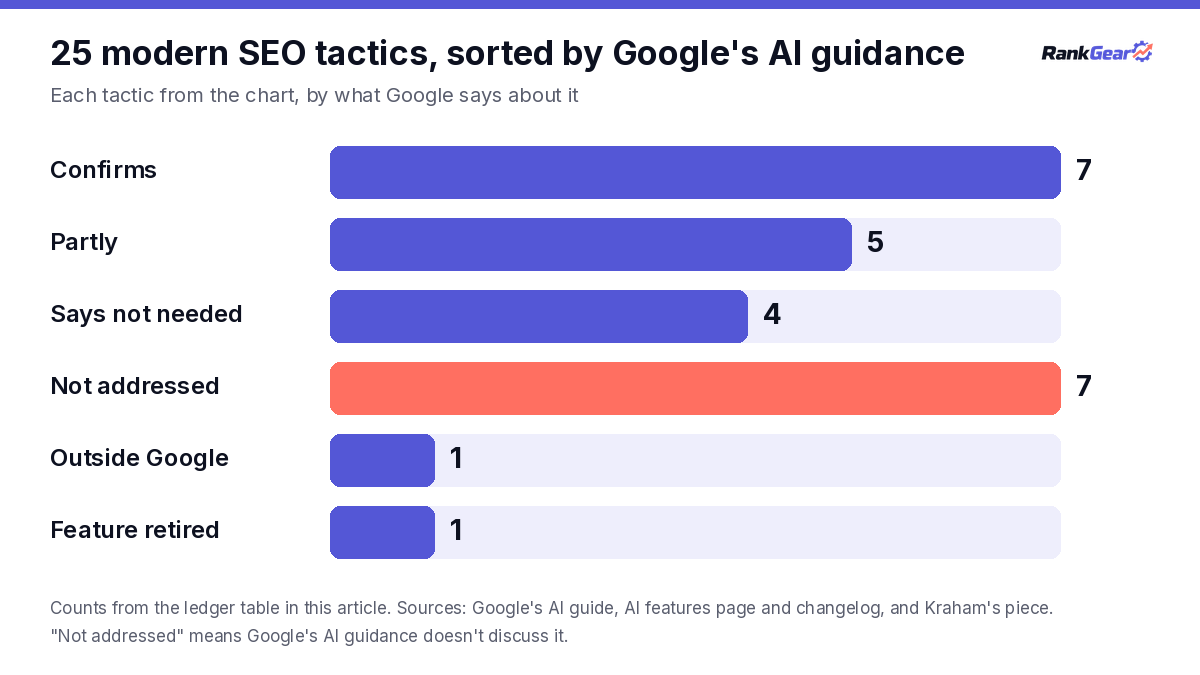
The table sorts all 25 chart items by what Google has said. It draws on two Google documents: the Search Central guide and Google's "AI features and your website" page (Google AI features page). Kraham's piece and Google's changelog fill in two rows. "Not addressed" means not addressed in Google's AI guidance. It does not mean Google denies anything.
Each status in the table means the following:
- Confirms: Google names it as something to do.
- Partly: Google covers part of it, or covers it with a limit.
- Says not needed: Google lists it as something to ignore or as not required.
- Not addressed: Google's AI guidance doesn't discuss it.
- Outside Google: it's about AI systems Google's guidance doesn't cover.
- Feature retired: the Google feature it targets is gone.
| System | Tactic | Status and what Google says | How to check it |
|---|---|---|---|
| SEO | Technical SEO | Confirms. The guide lists indexing with a snippet, crawling, JavaScript SEO, page experience and duplicate content. | Search Console indexing checks, a crawl, and the generative AI inclusion setting |
| SEO | On-page SEO | Partly. Google says people "appreciate it when web pages are organized by paragraphs and sections." | Compare your page with the pages ranking for the query |
| SEO | Topical authority | Not addressed. The term isn't used in either AI document. | Check whether you rank for related subqueries |
| SEO | Entity & semantic SEO | Not addressed as a term. Google says AI systems "can understand synonyms and general meanings." | Measure the field, and treat any link to rank as correlation |
| SEO | Off-page SEO | Partly. Seeking inauthentic mentions "isn't as helpful as it might seem." Links aren't discussed in the guide. | Don't treat link placements as Google-confirmed for AI features |
| AEO | Featured snippets | Not addressed in the AI guidance. | Check the live SERP for the feature |
| AEO | Question-based content | Not addressed. Google says you don't need to write "just for generative AI search." | Look for real question queries in Search Console (regex guide) |
| AEO | Voice search SEO | Not addressed. | No Google-confirmed method found |
| AEO | FAQ optimization | Feature retired. Google's changelog says the FAQ rich result "will no longer appear in Google Search starting May 7, 2026." | The SERP shows no FAQ rich result |
| AEO | AI Overview optimization | Says not needed. "There are no additional requirements to appear in AI Overviews or AI Mode, nor other special optimizations necessary." | Sample AI Overviews across many days |
| GEO | AI citations | Partly. Google states the eligibility rules only. | The generative AI report's Pages view, plus live sampling |
| GEO | LLM visibility | Outside Google. Google's guidance covers Google Search. | Test each platform on its own |
| GEO | Brand mentions | Partly. AI features "can show what's being said about products and services across the web," but inauthentic mentions aren't "as helpful as it might seem." | No Google metric exists for this |
| GEO | Entity signals | Not addressed. | Treat as practitioner theory |
| GEO | AI recommendations | Confirms for products and local businesses. Google names Merchant Center and Google Business Profile. | Merchant Center reporting and Business Profile accuracy |
| AIO | AI search visibility | Confirms a measure: the Search Console generative AI report. | The report's Pages view, paired with live SERP checks |
| AIO | AI content optimization | Says not needed for rewriting just for AI. AI-assisted content must meet Search Essentials and the spam policies. | Human review before publishing |
| AIO | AI Overview | Says not needed. This repeats the AEO item above. | Same as above |
| AIO | AI Mode optimization | Says not needed. Google also says AI Mode and AI Overviews "may use different models and techniques." | Sample both surfaces on their own |
| AIO | AI search analytics | Confirms the Search Console report. Kraham says third-party tools "have no access to our internal metrics." | Treat vendor visibility scores as samples |
| SXO | Search intent | Confirms in spirit: "Focus on what your users want." | Check the format of the live SERP |
| SXO | UX & page experience | Confirms. The guide says to "provide a good page experience." | Core Web Vitals and page experience checks |
| SXO | CRO | Partly. Kraham points to business goals such as leads and sales as the thing to measure. | Track leads and sales in analytics |
| SXO | Content experience | Confirms. Pages "organized by paragraphs and sections." | Read the page as a visitor would |
| SXO | Engagement & retention | Not addressed as a ranking input. Google says clicks from pages with AI Overviews "are higher quality." | Don't present engagement as a confirmed signal |
Where the Discovery Engine GEO theory goes too far
Treat Discovery Engine docs as Cloud docs in SEO vs GEO research
Discovery Engine's API docs are public. The RankSignals reference, read on 24 November 2026, named no field Gecko or Jetstream (Google Cloud RankSignals reference). The fields it lists include:
keyword_similarity_score,relevance_scoreandsemantic_similarity_scorepctr_rank,topicality_rankanddocument_ageboosting_factor,default_rankandcustom_signals
Metehan's post explains where those names came from. He writes, "The Cloud Console mentions Gecko, but there is also an embedding model named Gecko." Kitdev's audit, dated 23 August 2026, reports that a console column labeled "Gecko score" sits over semantic_similarity_score (Kitdev). It describes Google's JetStream as "a throughput-optimized TPU LLM-inference engine." Kitdev is a third party, and its audit is best read as a second opinion. The API fields above can be checked directly.
Metehan hedged his own post: "I'm not claiming Discovery Engine is exposing the full architecture of Google AI Mode & AIO. They're different products serving different purposes." He also wrote, "Is this exactly how AI Mode works? I can't say for certain." This review found no Google statement that consumer AI Mode or AI Overviews run on Discovery Engine.
Metehan's X bio, read through the X API on 24 November 2026, lists Peec AI. Peec AI describes itself as "an AI search platform that helps marketing teams understand and improve how their brands are discovered, represented, and recommended" (Peec AI). It isn't confirmed here whether that role applied when he wrote the post in November 2025.
Google Cloud's data store reference says chunkSize is "The token size limit for each chunk," with "Supported values: 100-500 (inclusive)" and a "Default value: 500." It lists includeAncestorHeadings with "Default value: False." (Google Cloud dataStores reference). The 500-token figure is that default setting, and a business that sets up its own search can change both values.
Compare two GEO claims on chunking a day apart
On 20 November, Groberman advised "clean chunk-level structure so useful answers can be extracted without digging through hundreds of words of filler." On 21 November, he wrote that "Google's post also pushes back on a lot of the shortcuts people have been selling." His list included "artificial snippets everywhere."
Google's guide lists chunking among the things you can ignore. It says, "Google systems are able to understand the nuance of multiple topics on a page and show the relevant piece to users."
Cyrus Shepard's review makes a close point about structure. He gives "AI-ready Structure" a score of 8.6. He writes that this doesn't mean breaking content into bite-sized pieces, and says to "simply provide a clear structure with headings, sections, tables, etc." (Cyrus Shepard, Zyppy). Michael King of iPullRank takes the other side on chunking. He writes, "The systems retrieve passages. Treat your passages like they matter, because the systems do."
Headings and clear sections fit what Google, Shepard and King each describe. Splitting pages into tiny fragments is the part Google says you can skip for Google Search.
Fan-out pages where GEO advice meets the spam policy
Groberman's 21 November post uses a payroll software example. He writes, "A company with useful pages across those different questions has more opportunities to be discovered while Google researches the answer."
Google's guide addresses fan-out pages directly: "While it might be tempting to create separate content for every possible variation of how people might search (for example, by focusing on other queries that people have asked, or fan-out queries), doing so primarily to manipulate rankings or generative AI responses in Google Search violates Google's scaled content abuse spam policy." It adds that "a high quantity of pages doesn't make a website higher quality or more relevant to users."
Covering the real questions a buyer has, on pages that help that buyer, fits Google's advice to create "non-commodity content." A page for every phrasing of a query, made to win AI answers, is what Google names under scaled content abuse. Read the policy and apply it to your own content plan.
What independent research shows about GEO and SEO overlap
Compare rankings with AI Overview citations for SEO vs GEO overlap
Ahrefs' 2 March 2026 study found that 37.9% of URLs cited in AI Overviews also appeared in the first 10 SERP blocks. Counting standard blue links only, 37.1% ranked in the top 10, and 36.7% didn't rank in the top 100 (Ahrefs, March 2026). Ahrefs' 21 July 2025 study had put the figure at about 76% (Ahrefs, July 2025). Ahrefs writes that since then "we've also improved our parsing methodology in Ahrefs." For that reason, the two numbers aren't a clean trend. The data came from Ahrefs Brand Radar, and Ahrefs calls it "our AI visibility tool."
A ranking and a citation can differ for the same page. RankGear's post on AI Overview citation volatility shows how to sample citations over many days.
Read Cyrus Shepard on citation factors in the GEO vs SEO overlap
Cyrus Shepard's 7 May 2026 review (Cyrus Shepard, Zyppy) drew on 54 experiments, patents and case studies and scored 23 factors. He writes, "I assigned each score by hand against those criteria, using AI to help adjust the final numbers." His top three are URL Accessibility (9.5), Search Rank (9.4) and Fan-out Rank (9.3). Structured Data scores 5.6, with the note "The effect is typically small, but it's amazingly consistent across studies." LLMs.txt scores 2.
He adds his own caveat about the scores: "Instead, they are features correlated with AI citations across multiple studies. Correlation is not causation." His scores are a hand-scored summary of correlations across studies. RankGear's guide to correlation vs causation in SEO explains how to use that kind of evidence.
The case against treating GEO and SEO as one
Michael King's 22 May 2026 column on Search Engine Land, first published on the iPullRank blog, argues against reading Google's guide as the full picture (Michael King, Search Engine Land). He writes, "Google's guidance on AI Search is one opinion. It is the opinion of the company with the most to lose from a multi-platform world." He notes that other AI systems make their own choices: "Some of those systems use Bing as their grounding layer." He adds that some build their own indices and some use llms.txt files.
King is founder and CEO of iPullRank. The agency lists "Generative Engine Optimization (GEO)" among its services (iPullRank, iPullRank team page).
His point limits what Google's guide can tell you, because the guide covers Google Search only. If ChatGPT, Perplexity or Copilot matter to your business, test those platforms on their own.
How to check GEO and SEO claims against the live SERP
Check AI search eligibility before any GEO tactic
Google states two rules: the page must be indexed and eligible for a snippet, and the site must be included in Search generative AI features in Search Console. Google began testing that setting on 3 June 2026 and says, "Sites that opt out will not receive traffic or impressions from our generative AI features" (Google, new controls). Per Google, a page that fails these checks isn't eligible to appear.
Read the Search Console generative AI report in your GEO vs SEO checks
Google launched the generative AI performance report on 3 June 2026. It says that as of 31 August 2026 the report has rolled out to all websites worldwide (Google, report launch, Search Console Help). Google lists impressions, pages, countries, devices and dates. Search Engine Journal reported on 31 August 2026 that the report "doesn't include click data as of publication" (Search Engine Journal). Queries aren't on Google's list either. Pair the report with the standard Performance report to see clicks and queries for the same pages.
Outside evidence on clicks is split, starting with Pew Research Center's 22 July 2025 analysis of the browsing data of 900 U.S. adults. Users who saw an AI summary clicked a traditional search result link in 8% of visits, against 15% for those who didn't (Pew Research Center). Google disputed the study and said in a statement, as reported by Search Engine Journal, "This study uses a flawed methodology and skewed queryset that is not representative of Search traffic" (Search Engine Journal). Google's AI features page also says clicks from results pages with AI Overviews "are higher quality (meaning, users are more likely to spend more time on the site)." Your own analytics can show which pattern fits your pages.
Sample AI Overviews and AI Mode in your GEO vs SEO checks
Google says, "AI Mode and AI Overviews may use different models and techniques, so the set of responses and links they show will vary." Treat them as two surfaces, and treat a single screenshot of either one as one sample. The volatility post linked above shows how to sample over time. For organic results, RankGear's Volatility feature repeats a query, "commonly five to thirty times," to show how much the SERP moves on its own.
Turn fan-out GEO advice into SERPs you can measure
Google's lawn example turns into a simple test: take a query you care about and write down the related subqueries a model might run. Then check each subquery as its own SERP to see whether you rank and which pages do.
In RankGear, you can run each subquery as its own field in an Analysis Run. An Analysis Run "fetches the pages ranking for that query, renders and measures each one across the 928-factor catalogue, calculates how every factor correlates with position, and places your page in that field." RankGear's page adds that it "shows what correlates with position on this SERP." The methodology page shows how the numbers are made. This article does not claim RankGear tracks AI Overview or AI Mode citations, connects to Search Console, or measures GEO. If you compare any tool's data with the live SERP, first check which version of Google the tool matched against (SERP data accuracy).
Run a controlled test before you pay for GEO advice
A correlation tells you where to look, and a controlled test checks one change. RankGear's write-up on how we run a controlled SEO experiment covers the method. Change one thing, keep the rest the same, put each test page on its own domain and wait for Google to index them. RankGear's Experiments page says, "An experiment measures how variants of one change placed in a live result set." If someone sells a GEO tactic, ask for a test like this, with its method, sample and dates.
GEO vs SEO FAQs
Is there a real GEO vs SEO difference?
For Google Search, Google says no. Its May 2026 guide calls optimizing for generative AI search "still SEO." Michael King and others argue that other AI platforms make their own retrieval choices. Outside Google, the answer can differ.
Does Google need LLMs text files for AI search optimization?
Google says no, because Google Search ignores LLMS.txt files. Its guide says they "will neither harm nor help" visibility in Google Search, and other services may use them.
Should you chunk content for generative engine optimization?
Google says, "There's no requirement to break your content into tiny pieces." Clear headings and sections help readers, and Cyrus Shepard's review scored clear structure 8.6. See Compare two GEO claims on chunking a day apart.
Do FAQ sections help with AEO vs SEO?
The FAQ rich result stopped appearing in Google Search on 7 May 2026, according to Google's changelog (Google Search Central updates). FAQ content can help readers who have those questions.
Can an AI search optimization tool see Google data?
Google says, "No third-party tool has access to our internal ranking or AI systems." Tools can sample what AI answers show, and their scores are best read as samples. RankGear's AI SEO audit post covers how to check where an AI tool's findings come from.
Does RankGear track AI Overview citations for GEO?
No, and RankGear's citation volatility post gives the same answer. RankGear's Analysis Run measures the organic field for a query. See Turn fan-out GEO advice into SERPs you can measure for how to use it next to AI checks.
Start your GEO vs SEO checks on Monday
- Check that your key pages are indexed, snippet-eligible and included in generative AI features in Search Console.
- Open the generative AI performance report and note which pages get impressions.
- Pick five fan-out queries for one topic and look at each live SERP.
- Read the original source before you buy anything sold as a Google leak.