Feature · Create
Content Intelligence: build the brief from the SERP, score the draft before you publish
Turn a target query into an evidence-built brief — topical coverage, entities, questions, densities — then pressure-test a draft against the live field before it ever becomes a URL.
The Topical Heatmap
Coverage against the field’s consensus
The Topical Heatmap compares exact whole-term counts across your page and every competitor, for four evidence groups — each with Page 1 usage, the Page 1 median, your count, the gap, the evidence source and reason, a priority weight, and a formula-backed coverage score. Your page is excluded from its own benchmark.
- Keyword Variants
- The ways the field expresses the core query.
- Entities
- The named things the winning pages consistently reference.
- Related Topics
- Adjacent themes that signal completeness.
- Supporting Terms
- The vocabulary that fills a topic out.
Visible bands make the gaps obvious: 0 Missing, 1–2 Light, 3–9 Covered, 10+ Strong.
The research surface
Questions, entities, and the terms that matter
Questions & Question Plan
The questions the field answers, organized into a plan you can write against.
Entities & Entity Gaps
Which recognized entities appear, where the gaps are, and how densely they’re covered.
LSI, YAKE & Related Searches
Related terms and keyphrases surfaced several ways, plus the SERP’s related searches.
Sentences & Cluster Data
Representative sentences and the cluster structure of the field.
Variation review
Related searches and rank-signal terms sorted into likely variants, related topics, or excluded noise — you approve any that get measured.
Semantic Evaluation CSV
An optional export of the full candidate corpus with blank human-label fields, for your own review.
BM25 Drafts: score it before Google does
BM25 Drafts reads your HTML, Markdown, or text, fetches the current field, and reports where the draft’s relevance places within it — a comparable BM25 score and an estimated slot in the live field. Alongside it: multiple word-count definitions, five densities, entities, related terms, signal-weighted density, and the position-tracking terms your draft is missing. Revise on evidence, before it’s a live URL.
See how we measure →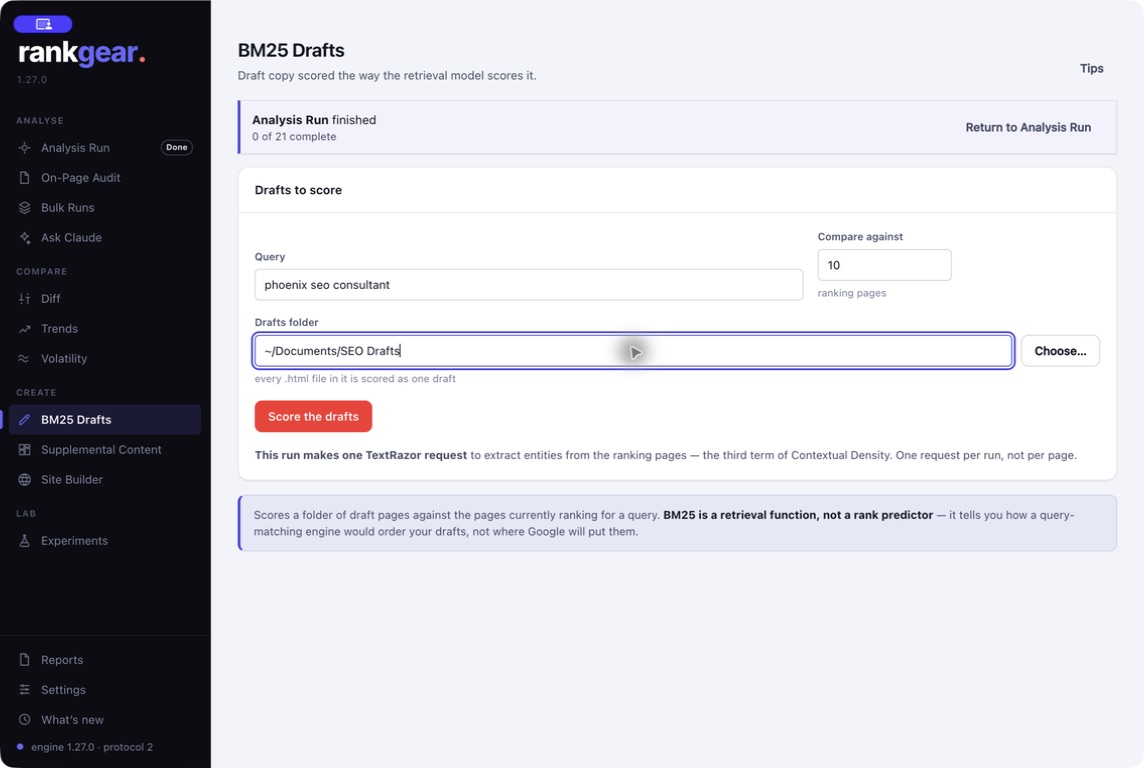
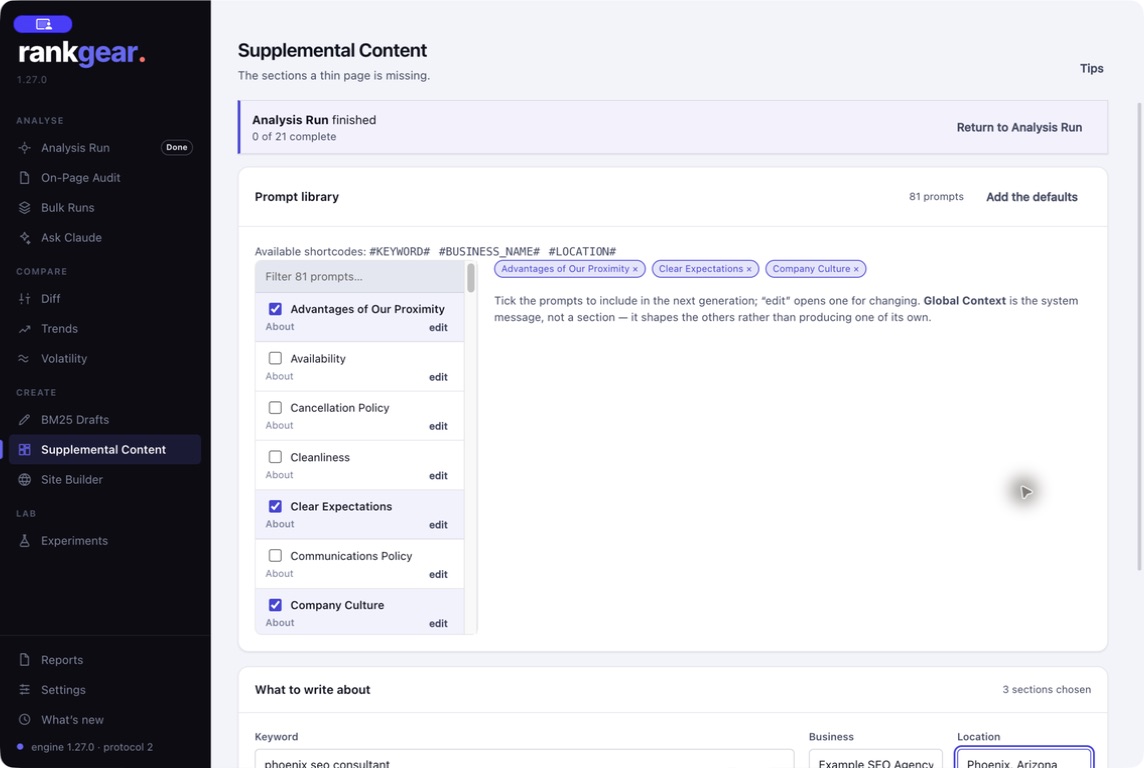
Supplemental Content: sections that earn their place
81 Nova-designed section prompts, all editable, with live #KEYWORD#, #BUSINESS_NAME#, and #LOCATION# shortcodes. Generate genuinely useful supporting sections — decision frameworks, diagnostics, mechanisms, verification steps — with your own Claude or OpenAI account, and export as HTML, TXT, Markdown, or PDF. The defaults forbid invented credentials, reviews, statistics, and quotes; everything is built for human review, never auto-published.
Boundaries
Coverage, not stuffing
The Topical Heatmap is a comparison matrix, not a density target — it shows where the field has consensus and where your page is thin, and it never tells a writer to force a phrase. BM25 “would rank” is a relevance placement in the corpus, not a live-position forecast. Entity extraction and any AI generation use your own provider accounts and must be reviewed.
Correlation, not causation. Topical coverage and BM25 placement are comparisons against the field — evidence for a better brief, not a ranking guarantee.
Questions, answered
Does it write content for me?
It builds the evidence and can generate supplemental sections with your own AI provider — but generation is optional, billed to you, and always for human review.
What does the Topical Heatmap score?
A formula-transparent comparison of exact term coverage across the field, weighted by category and Page 1 usage, banded Missing / Light / Covered / Strong. Not a density target.
Does BM25 predict my ranking?
No. It places a draft’s relevance within the current comparison corpus — a ‘where it slots’ read, not a forecast of a live Google position.
Can I review the variants before they’re used?
Yes. You approve any measured variation explicitly, and the optional Semantic Evaluation CSV exports the full candidate corpus for your own labelling.
Build the brief from evidence.
Then write for humans — and check the draft against the field before it ships.
macOS 14+ (Apple silicon) · Windows 11 (x64/ARM64) · bring your own provider accounts