
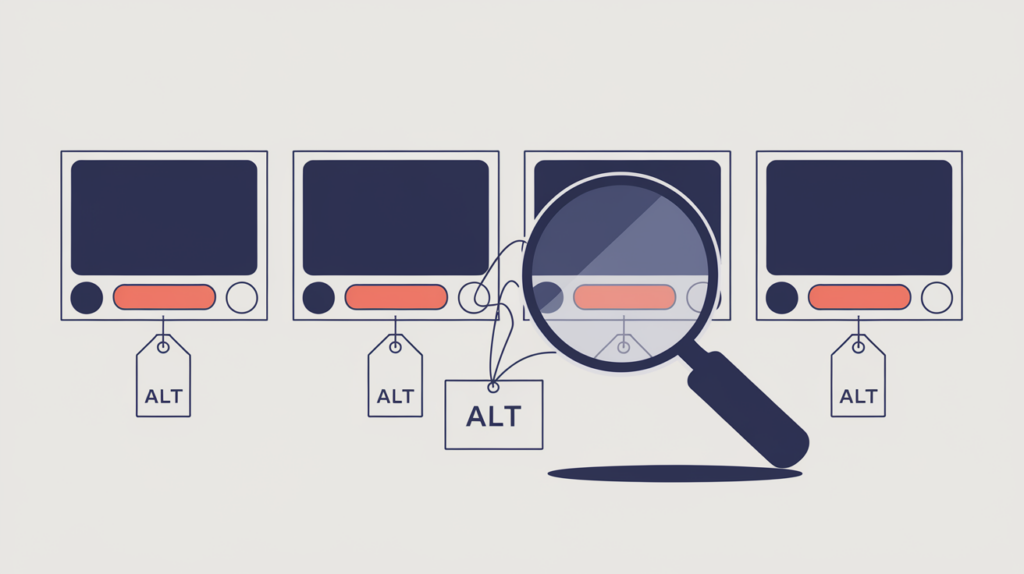
Variations in ALT Attributes counts how many times the run’s keyword variations appear in the page’s image alt attribute values. It is an occurrence count that shows whether image alternatives use query-related language — not the number of images that carry relevant ALT text, and never a judge of whether the ALT text actually describes the image.
| Factor ID | RG-MED-008 |
|---|---|
| Family | Media & embeds |
| Measurement | Occurrence count |
| Measured zone | ALT attributes in the rendered page body |
What it measures
This factor counts occurrences of the run’s keyword variations inside recognized alt attribute values. It surfaces whether the image alternatives on a page use language related to the query, giving a view of how well the visual layer echoes the page’s topic for readers who rely on ALT text.
How RankGear measures it
RankGear extracts the quoted ALT values from the rendered, script-free body, cleans their HTML, and counts case-insensitive, word-aware matches drawn from the run’s variation set. Longer terms are processed first and overlapping text is consumed, so a phrase is not double-counted by its shorter fragments. The output is a total occurrence count — it is not the number of images with relevant ALT text, and one image can contribute more than one match.
What RankGear looks for
<img src="keyword-research-dashboard.png"
     alt="keyword research dashboard showing variation counts">

<!-- decorative image, correctly empty -->
<img src="divider.svg" alt="">| Value | Meaning |
|---|---|
| 0 | No variation language was found in any ALT value — either the images have no ALT text, or their ALT text does not use query-related terms. |
| Higher count | More variation matches across the page’s ALT values. Read it as an observation of topical language in image alternatives, not a target to inflate. |
How to optimize it
Write concise ALT text that communicates each image’s purpose or content to people who cannot see it. Include a relevant topic variation only when it accurately describes the image, and use empty ALT text for purely decorative images when that is appropriate. Treat the count as an observation of how your image alternatives read, not a number to push upward — the right ALT text for the image always wins over a higher score.
Important considerations
- Accessibility is the primary purpose of ALT text; describing the image for people who cannot see it comes first.
- Keyword stuffing ALT values to raise the count makes the alternatives worse for users.
- The factor does not judge descriptive accuracy — it only counts variation matches, so a high count is not proof the ALT text is good.
- A decorative image correctly using empty ALT text should not be changed to raise the score.
- This is a correlation-based prioritization signal that relates to position within a measured result set. It does not, on its own, make a page rank or guarantee any ranking.
Related factors
Part of the Factors reference · how RankGear measures · glossary.