
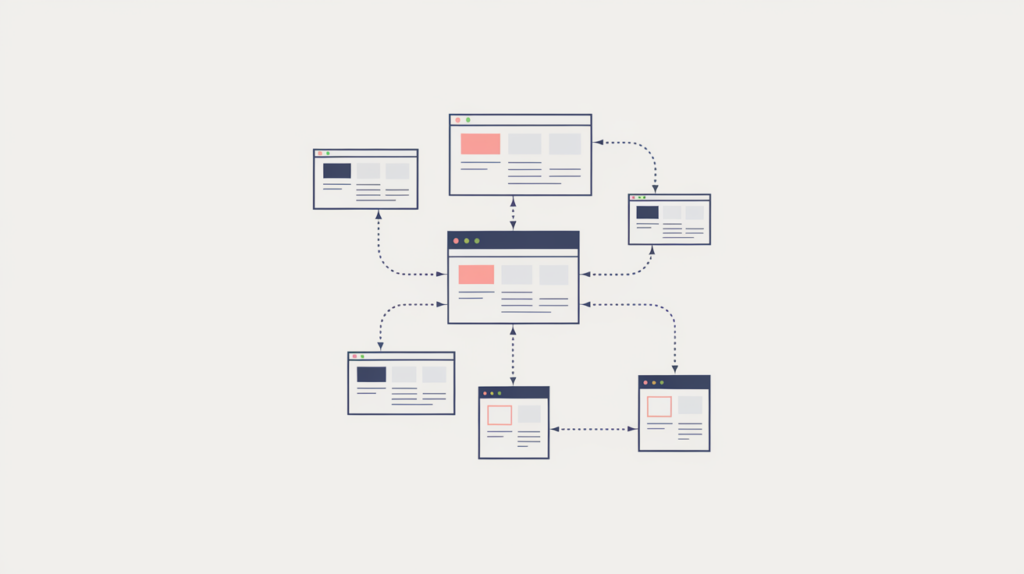
Number of Internal Links counts the anchor elements on a page that RankGear classifies as pointing within the analyzed page’s own host. It’s a raw count of elements — not unique destinations, not link quality, and not authority passed — so read it as a navigation-pattern signal across the ranking field, never a number to inflate.
| Factor ID | RG-LNK-010 |
|---|---|
| Family | Links on the page |
| Measurement | Anchor-element count |
| Measured zone | Rendered page body |
What it measures
This factor counts recognized anchor elements that RankGear classifies as belonging to the analyzed page’s host or as non-absolute links. It lets you compare internal navigation and site-connection patterns across the pages ranking for a query. It counts elements — not unique destinations, link usefulness, crawlability, anchor quality, or the amount of authority a link transfers.
How RankGear measures it
RankGear parses anchors from the rendered, script-free page body. An absolute HTTP or HTTPS link is treated as internal when its host matches the analyzed page’s host. Relative URLs, and any link RankGear does not classify as an absolute HTTP or HTTPS URL, are also counted as internal. Because of this compatibility rule, fragment links and non-HTTP schemes can contribute to the internal count. A different subdomain is normally treated as a different host, and therefore external.
What RankGear looks for
<a href="/services/audit">…</a>                relative path    → internal
<a href="https://rankgear.com/pricing">…</a>   same host        → internal
<a href="#methodology">…</a>                    fragment         → counted internal
<a href="mailto:hi@rankgear.com">…</a>          non-HTTP scheme  → counted internal
<a href="https://blog.rankgear.com/">…</a> other subdomain → externalHow to optimize it
Treat the count as an observation, not a target. Create internal links that help users and crawlers reach relevant supporting pages — related services, evidence, definitions, next steps, and important conversion paths. Use clear anchor text and place links where their destination is genuinely useful. Remove broken, redundant, misleading, or excessive template links, and strengthen the connections to your important pages without turning every repeated phrase into a link. A higher number is not automatically better; a page dominated by template links can carry a large count while linking to very little of substance.
Important considerations
- Navigation, footer, sidebar, and repeated template links can dominate the total.
- Multiple links to the same URL are counted separately — this measures elements, not unique destinations.
- Different subdomains may be classified as external.
- Non-HTTP links (such as
mailto:or fragment anchors) can contribute because of RankGear’s compatibility classification. - Review unique destinations, anchor text, page importance, and crawl structure alongside the raw count.
- This factor correlates with position within a measured result set; it is a prioritization signal, not a cause of ranking, and no count guarantees a position.
Related factors
Part of the Factors reference · how RankGear measures · glossary.