
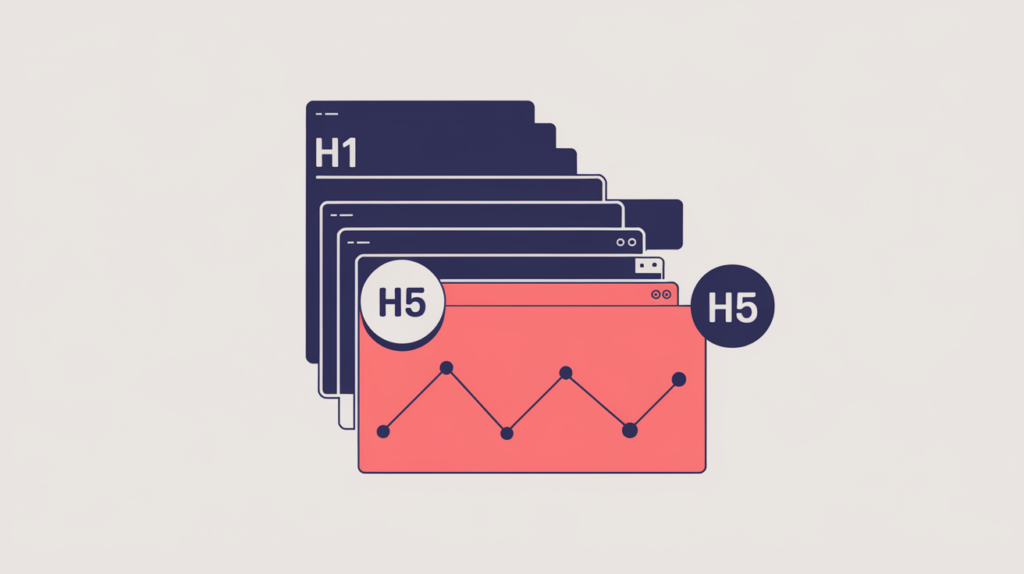
Variations making whole H5 tags counts how many of a page’s H5 headings are made entirely from a single keyword variation — the whole heading, and nothing else. Because any extra word in the heading breaks the match, it is an observation about how your subsections are labeled, not a target to chase.
| Factor ID | RG-HDG-050 |
|---|---|
| Family | Headings |
| Measurement | Whole-heading variation match count |
| Measured zone | H5 text |
What it measures
This factor counts the H5 headings on a page whose text is made up entirely of one keyword variation. Only a heading whose full text is a single variation — with no words before or after it — is counted. An H5 that carries a variation alongside other text does not qualify, so this is a count of exact-match H5s rather than of headings that merely contain a variation.
How RankGear measures it
RankGear evaluates the parsed text of each H5 with a case-insensitive regular expression built from the sorted list of variation alternatives, anchored at the start and end of the string. The anchoring is what enforces the whole-heading rule: the H5 text has to match a variation from beginning to end, so any leading or trailing text produces no match. The variation strings are placed into the pattern as-is and are not regex-escaped.
What RankGear looks for
Pattern (case-insensitive, anchored):
    ^(variation-a|variation-b|variation-c)$

Applied to each H5’s text:
    <h5>variation b</h5>            → counts (whole heading is the variation)
<h5>variation b explained</h5> → no match (extra text breaks the anchor)| If the H5 is… | Result |
|---|---|
| Exactly one variation, any letter case | Counts toward this factor |
| A variation plus any other word(s) | No match — not counted |
| Not a variation at all | No match — not counted |
How to optimize it
Use a variation as an entire H5 only when the document hierarchy genuinely reaches the H5 level and the phrase clearly identifies that subsection. Treat this count as an observation about how your headings are structured, not a quota to fill — inserting bare H5s just to raise the number works against readable structure. Many well-organized pages have no H5s at all, so a value of zero is neither wrong nor a deficit; let the content’s organization decide whether an H5 belongs there.
Important considerations
- Additional text in the heading results in no match — the H5 must be the variation and nothing else.
- Variation characters are not regex-escaped, so any regex-special characters inside a variation can change how the pattern matches.
- Many well-structured pages have no H5s, so a count of zero is common and expected, not a problem to fix.
- Content organization should determine whether an H5 is used, not this metric.
- Correlation, not causation: this count relates to position within a measured result set; it does not make a page rank or guarantee any position.
Related factors
Part of the Factors reference · how RankGear measures · glossary.