
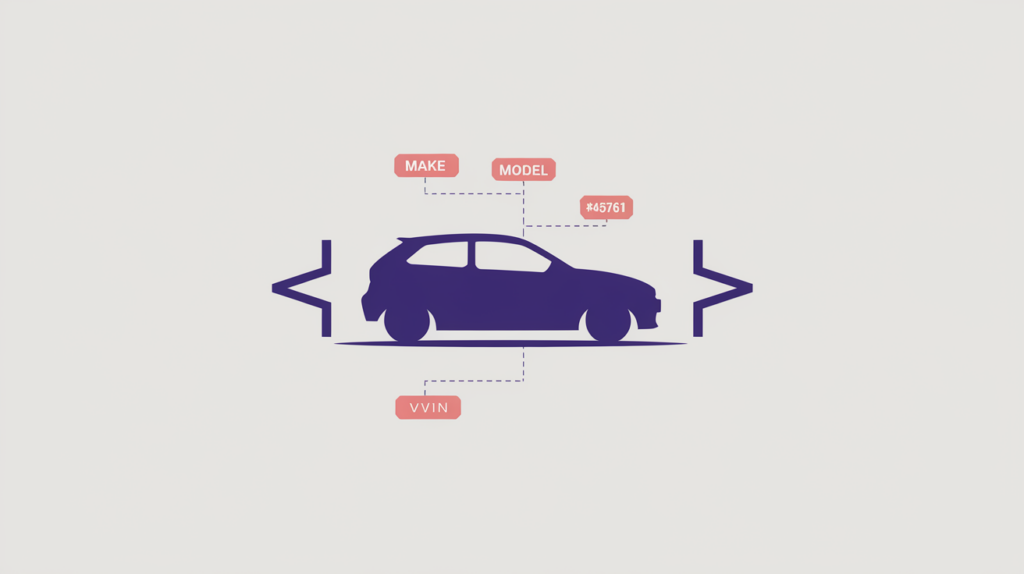
Has JSON-LD Vehicle reports whether RankGear finds a Vehicle @type declaration in the page’s raw source. It returns a simple yes/no (1 or 0). Because the check pattern-matches the source text rather than validating a JSON-LD graph, a matching string can register even when it sits outside valid structured data.
| Factor ID | RG-SCJ-262 |
|---|---|
| Family | Structured data — JSON-LD |
| Measurement | Binary presence (0 / 1) |
| Measured zone | Raw rendered HTML |
What it measures
This factor reports whether RankGear finds an @type value of Vehicle in the raw source. It is a presence signal for a single JSON-LD entity type used to describe an individual vehicle — make, model, identifiers, specifications, condition, mileage, and offer details — not a measure of how complete or correct that markup is.
How RankGear measures it
RankGear searches the raw HTML for "@type": "Vehicle", allowing flexible whitespace around the colon and optionally accepting a schema: prefix. Matching is case-insensitive, so capitalization differences do not affect the result. If the pattern is found the factor returns 1; otherwise it returns 0.
What RankGear looks for
<script type="application/ld+json">
{
  "@context": "https://schema.org",
  "@type": "Vehicle",
  "name": "2021 Example Model",
  "vehicleIdentificationNumber": "..."
}
</script>| Value | Meaning |
|---|---|
| 1 | A Vehicle @type string was found in the raw source. |
| 0 | No Vehicle @type string was found. |
How to optimize it
Use the Vehicle type only for a specific vehicle, with accurate make, model, identifiers, specifications, condition, mileage, and offer details. Ensure every property reflects content users can actually verify on the page. Treat this factor as an observation of whether the markup is present, not a target to chase: adding the string without genuine, matching page content does not improve the underlying page.
Important considerations
- The detector pattern-matches source text instead of validating a JSON-LD graph, so a positive result is not proof of valid structured data.
- A matching string that sits outside valid JSON-LD — in a comment, example block, or script that never parses — can still produce a 1.
- Capitalization differences do not affect detection.
- Validate the complete structured data independently with a dedicated schema validator.
- This is a correlation-based prioritization signal within a measured result set. Presence of
Vehiclemarkup relates to position; it does not by itself make a page rank or guarantee a result.
Related factors
Part of the Factors reference · how RankGear measures · glossary.