
On 4 October 2026, Nozzle stored a normal page 1 for the desktop search "white label local seo" in the United States. On 7 October, the same keyword, device and location came back with 9 of 9 page-1 sites gone, and pagination had shrunk from 10 pages to 3 (Nozzle Research). Nothing on the page said anything was wrong, and Nozzle says "a rank report reads it as a crash."
That is a poisoned SERP. The page loads normally for an automated request, with no error and no captcha, but it lists different results from the ones a person sees. Since mid-September 2026, rank-tracking and SERP data vendors have reported it. They include Nozzle, AccuRanker, Ahrefs, Semrush, SE Ranking, DataForSEO and SerpApi. As of 16 November 2026, one day's rank check is not evidence, the same rule we apply to AI Overview citations. Test a drop against a clean baseline, Search Console and the live SERP before you report it.
What poisoned SERPs are, in plain terms
SerpApi's definition is short: "A Google Search request can succeed but return the wrong results." Some automated searches get "a page that looks normal, even though the results can differ sharply from what someone sees when they run the same search manually" (SerpApi). Search data providers came up with the term, and SerpApi puts "poisoned" in quotation marks.
Nozzle's definition is easier to measure. A keyword's usual sites are the ones in its top 10 on at least 60% of its SERPs from 20 August to 9 September 2026. A page counts as poisoned when fewer than half of those usual sites appear anywhere on the SERP (Nozzle Research).
A poisoned page is worse for a tracker than a block. In Nozzle's interpretation, a refused request "tells a scraper to try again," while "a poisoned one gets stored as real."
What SerpApi says about poisoned search results
SerpApi published "What We're Seeing in Google's 'Poisoned' Search Results" on 12 November 2026. It has seen the problem in its Google Search API on the first page and on later pages. In Google Shopping, "an iPhone search returned other products in the top four spots," and it has also seen the behavior on Bing.
The key passage, which Glenn Gabe quoted on X, is about baselines: "Rank trackers can compare a keyword's results with its ranking history to spot an unusual change. A real-time search API often sees a query for the first time, so it has to make sense of the results without that baseline." SerpApi adds that "getting accurate results for one search tells us little about how the next search will behave."
RankGear adds one condition. A baseline only protects you if it was built before the data went bad, and if you check it against a page Google served to a person.
SerpApi sells a SERP API. Its post describes a problem with the data its own product returns. The post gives no rate, sample size or method. Its status page says "about 6% of the results are returned as poisoned" in its engineers' benchmarks on 26 October 2026 (SerpApi status). SerpApi's 12 November 2026 post says it has "adjusted how we collect results to reduce how often this happens," and that it still sees the problem from time to time. The incident was still open as of 16 November 2026, and the latest update, on 9 November, said SerpApi was continuing to investigate.
A timeline of poisoned Google results
- 15 January 2025: SerpApi dates Google's JavaScript requirement for Search to this day (SerpApi).
- Around 10 September 2025: reports began that the &num=100 parameter, which showed 100 results per page, had stopped working (Search Engine Journal).
- Late January 2026: AccuRanker says its stored rankings show "smaller rounds of the same pattern," running at about 7 to 10 times their 2025 level from April to July (AccuRanker).
- 4 May 2026: SerpApi opened GitHub issue #3781 for irrelevant or poisoned Google results (GitHub).
- 13 September 2026: "requests to Google started failing in large numbers," according to Nozzle.
- 20 September 2026: Nozzle sees the first poisoned SERPs.
- 24 September 2026: AccuRanker calls this "the big step, not the first one."
- 13 October 2026: SerpApi opens a status incident.
- 16 to 27 October 2026: SE Ranking (16 October), AccuRanker (19 October), Ahrefs (22 October) and Semrush (27 October) publish notices.
- 2 November 2026: Nozzle's worst day, with 68.6% of SERPs poisoned on page 1 or 2.
- 12 November 2026: SerpApi publishes its post.
- 16 November 2026: DataForSEO launches a
resolve_poisoned_resultsparameter.
How much rank tracking data is affected
Each figure below is a vendor's measurement of its own traffic. Each one uses its own sample and its own definition. None has been independently audited, and we found no neutral measurement.
| Vendor | What it reports | Date | Source |
|---|---|---|---|
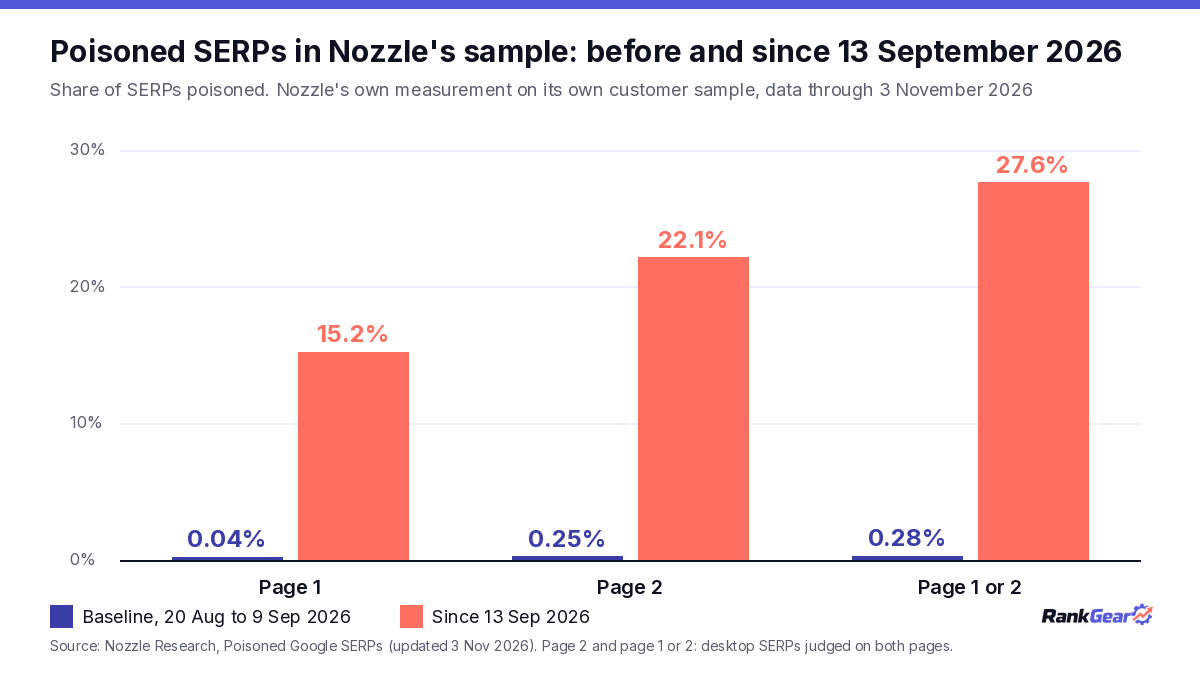
| Nozzle | 27.6% of SERPs poisoned on page 1 or 2 since 13 September, against 0.28% before. Page 1 alone: 15.2% vs 0.04%. Page 2: 22.1% vs 0.25%. Worst day: 68.6% on 2 November | Data through 3 November 2026 | Nozzle Research |
| AccuRanker | After its checks, 0.6% of desktop and 1.0% of mobile keywords in its sample still had a swapped page 1 on 25 October. On the first day, more than a quarter of its monitored sample came back swapped | 19 October 2026, updated since | AccuRanker |
| Ahrefs | "Depending on the data provider, we're seeing between 5% and 20% of search results affected." Later: "Page one data is now largely recovered and stable." | 22 October 2026, updated 6 November 2026 | Ahrefs |
| Semrush | No rate published. Describes two forms and excludes clearly invalid results | 27 October 2026 | Semrush |
| SE Ranking | "The issue still affects roughly 2% of tracked results" | 16 October 2026 | SE Ranking on X |
| SerpApi | "about 6% of the results are returned as poisoned" in its benchmarks | 26 October 2026 | SerpApi status |
| DataForSEO | No rate published. Launched a parameter that checks organic results against Google's Web mode | 16 November 2026 | DataForSEO |
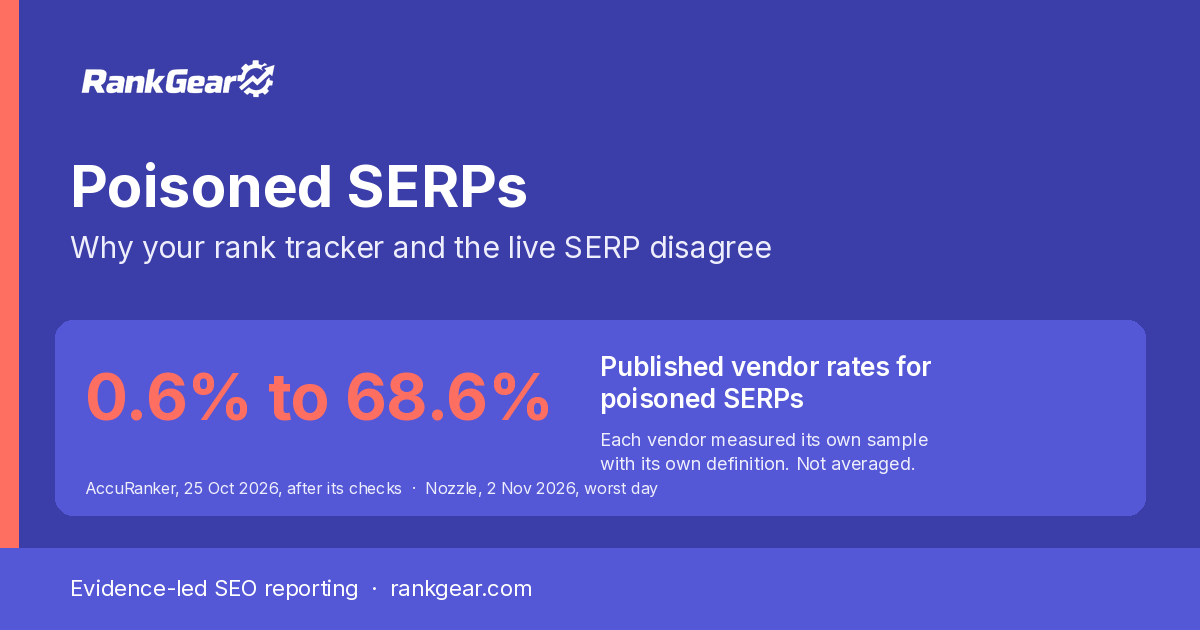
The published rates run from 0.6% to 68.6%. The gap comes from what each vendor counts. Nozzle's 27.6% counts desktop SERPs judged on both pages, where page 1 or page 2 failed. Its 15.2% counts page 1 alone. AccuRanker's 0.6% is what was left after its own filters, on "a fixed sample of 1 in every 200 tracked keywords." Ahrefs reports a range across data providers. Most vendors report their rate after their own cleanup. Each one also sells rank or SERP data. Averaging them would mix rates that count different things. This article quotes each figure as that vendor's claim.
Search Engine Journal's 14 October report quoted different numbers from Nozzle's first version: poisoned results kept 20.7% of sites against 88.5% for normal ones (Search Engine Journal). The current Nozzle page, updated 3 November 2026, says poisoned organic results keep 30.0% of the previous SERP's sites, against 88.2% before. The two versions count different things. When you cite Nozzle, quote the current version with its date.
What Google has and has not said about poisoned search results
As of 16 November 2026, Google hasn't commented publicly on poisoned SERPs. Semrush wrote on 27 October that "Google hasn't commented publicly" (Semrush). Search Engine Watch reported on 19 October that Google "hasn't said anything publicly about the swapped results trackers are seeing" (Search Engine Watch).
Google's spam policies define machine-generated traffic as "sending automated queries to Google." Google says this "includes scraping results for rank-checking purposes or other types of automated access to Google Search conducted without express permission." It adds that such traffic "consumes resources and interferes with our ability to best serve users" (Google spam policies). The policy page does not mention poisoned results.
Google has given its own reasons for earlier changes. In January 2025, a Google spokesperson told TechCrunch: "Enabling JavaScript allows us to better protect our services and users from bots and evolving forms of abuse and spam" (TechCrunch). After &num=100 stopped working in September 2025, a Google spokesperson told Search Engine Land: "The use of this URL parameter is not something that we formally support." Google did not say why it made the change (Search Engine Land).
Google sued SerpApi in December 2025, accusing it of circumventing security measures (Google). SerpApi says the court dismissed Google's amended complaint on 9 November 2026, with 21 days for Google to file a new one (SerpApi).
No one has shown what causes it. Nozzle calls it "Google's response to AI scraping, and rank trackers are caught in it." Google hasn't confirmed that, and it's too early to tell what is driving it. This article does not claim Google is doing it deliberately.
Rank tracker vs live SERP: the legitimate reasons they differ
Rank trackers and the live SERP disagreed before any poisoning. Google itself describes why. Google says its systems weigh signals "including the words of your query, relevance and usability of pages, expertise of sources, and your location and settings" (How Search works). A tracker set to United States desktop will not show the page a client sees on an iPhone in Queens.
Google also says: "Anytime we personalize Search results to be more helpful, we let you know," through its "About this result" feature. No source we found measures how much personalization moves a given SERP.
Since &num=100 stopped working, a tracker needs more requests to reach deeper positions. Search Engine Roundtable quoted one SEO, Daniel Skov Jacobsen, on 9 October 2026: "Most now sample instead of counting, so some daily swings are measurement noise" (Search Engine Roundtable). It is one SEO's claim. AccuRanker says cut-down pages "have doubled, to 4.0% of our desktop requests."
Blocking adds more noise, according to Derek Perkins of Nozzle. He told Search Engine Roundtable that Google uses "Super wide IP blocking, which targets major residential proxy networks," "a significant increase in the use of captchas," and bad data injected into suspect SERPs. Those are his words, not Google's. Search Engine Roundtable also reports that Google began testing goto redirects in results in July 2026.
Local searches: rank tracking data vs real local variation
Nozzle reports that "near me" searches were poisoned 26.0% of the time, against 14.6% for everything else. Brand searches were lowest, at 8.1%, and legal and home services ran highest. For local SEOs, the key finding is that "Local targeting makes no difference": the same phrase tracked nationally and locally comes out at 15.8% and 16.0% (Nozzle Research).
So a swing that shows up at both national and city level is less likely to be local variation. Nozzle's study covers organic SERPs only, and we found no measurement of poisoning in Maps or the Local Pack. This article does not extend the finding there. Check local service and near me keywords first when a report shows a sudden fall.
How to tell a poisoned SERP from a real ranking drop
Run these seven checks before anyone reports a loss.
- Compare with a clean window. Look at the keyword's usual sites before 13 September 2026. Nozzle says to compare "with its usual sites over the previous weeks, not with yesterday, which may have been poisoned too."
- See whether most competitors vanished too. AccuRanker counts a page 1 as poisoned when its top 10 keeps fewer than half of the sites from the day before and fewer than half from the day after. It calls this the sandwich check. When most of the usual competitors disappear at once, look at collection first.
- Wait a few days. Nozzle says 45.1% of poisoned SERPs have their usual sites back within three days, and 89.0% within two weeks. "A real ranking change stays."
- Check Search Console clicks for the same page, query and days. Semrush advises: "compare against your own data, such as Google Search Console." Nozzle says: "If a site 'disappears' and Search Console still shows impressions and clicks, nothing happened to the site."
- Check the page depth. Nozzle says page 2 is poisoned "one and a half times as often" as page 1. Ahrefs says it is rejecting more abnormal results "for page two and beyond," so updates there may be delayed.
- Spot-check poisoned SERPs in your own browser. Run the search yourself at the target location and compare it with what your tracker stored. One practitioner told Search Engine Roundtable that spot-checking in an incognito window was the only way they trusted a movement. That is anecdotal. Nozzle's 11 November 2026 AMA summary says: "We haven't seen any evidence of poisoning in logged-in results" (Nozzle). To keep a record, RankGear's free Browser SERP Chrome extension exports the organic results of a regular Google web search in your own browser to a CSV with the query, collection order, URLs and capture time. RankGear's page says those results "reflect your browser's session, account and location, not a certified neutral Google ranking," and that collection order "is not a verified Google ranking." The page also notes that Google restricts automated querying without express permission, and that this is user-initiated research. Treat a capture as a snapshot of your own session. This article does not claim it detects poisoned SERPs.
- Ask your provider what it filters and whether it backfills. Ahrefs says it is "cleaning up any past results that may have been affected." Semrush says it excludes clearly invalid results and collects flagged ones again. SE Ranking says ranking data "has also been corrected for all affected dates."
For agencies, Nozzle's advice in its 11 November 2026 AMA summary is: "Put big annotations around September 13 to today in any of your reports, rank tracking or GSC." The same caution applies during the November 2026 core update, when a core update and unreliable SERP samples move at the same time.
Search Console as a cross-check for a ranking drop, and its limits
Google defines an impression as "How often someone saw a link to your site on Google," and says average position "averages the position value for all impressions" (Search Console Help). Search Console adds up data from real searches. A rank tracker is one fetch from one location and device, so the two will disagree even on a clean day.
Search Console numbers have shifted before. After &num=100 stopped working, Tyler Gargula's analysis of 319 properties found that 87.7% lost impressions and 77.6% lost unique ranking queries, as reported by Search Engine Land. Brodie Clark and others suggested that scraper bots had been inflating impressions. Search Engine Journal calls this "a community theory at this stage" (Search Engine Journal), and Google hasn't confirmed it. For that reason, lean on clicks more than impressions.
What poisoned SERPs mean for SERP APIs, AI agents and SEO research
By SerpApi's account, SERP APIs have it harder. A real-time API "often sees a query for the first time," so it has no history to compare against. DataForSEO's new parameter "compares its organic results with a reference page retrieved through Google's Web mode" and replaces affected listings. DataForSEO charges a fixed fee equal to one extra SERP page (DataForSEO). DataForSEO describes it this way, and this article has not tested it.
AI agents face the same risk, since SerpApi says an agent "might base its answer on sources that wouldn't normally appear for that search." If you build agent workflows on SERP data, like the setup in our Monid SEO case study, check where the results come from.
SEO research built on SERP samples since mid-September may be contaminated. Nozzle founder Derek Perkins said of visibility studies published since then: "Every single one of those studies is based on poisoned data" (Nozzle). This is Nozzle's view. A ranking change in this window is a timing association, as our guide to correlation vs causation in SEO explains. A controlled SEO experiment needs a clean baseline and a control. Annotate those tests or run them again.
How we read live SERP samples in RankGear
RankGear's SERP data comes from the same kind of providers. Google and Bing organic SERPs use SerpApi or Bright Data, through the provider account you connect (RankGear download page). So RankGear runs, Volatility included, get the same responses those providers get. We have no data on how often RankGear runs have pulled poisoned pages, and this article does not claim RankGear detects, filters or corrects them. As of 16 November 2026, this is how we read any SERP sample, ours included:
- Keep pre-13-September workbooks as your baseline. Use Diff for baseline/current factor, rank, or progress changes, and Trends for multi-run history. Trends depends on consistent query context and saved history.
- Read a Volatility score since mid-September as movement. Volatility repeats the same query across a chosen number of samples and records positional movement. It does not explain the cause of that movement, and each sample is a separate billable SERP fetch. Since mid-September 2026, a Volatility run measures both real SERP movement and any collection artifacts in the provider's responses, so a high score does not by itself mean the query is restless.
- Hold location and device constant. RankGear analyzes the result set that exists for this query, location, language, device, and depth.
- Cross-check against Search Console clicks before you report a drop.
Compare two runs: your last clean workbook from before 13 September 2026 and your newest one.
Rank tracker accuracy FAQs
Is a poisoned SERP the same as a ranking drop?
No. A poisoned SERP is a collection problem that makes a tracker report a drop. Nozzle says a site that usually ranks for a keyword misses the top 10 on 63.7% of poisoned SERPs, against 2.6% before (Nozzle Research). See How to tell a poisoned SERP from a real ranking drop.
Has Google confirmed poisoned search results?
No. As of 16 November 2026, Google hasn't commented publicly. Its spam policies say scraping results for rank checks without permission breaks them (Google spam policies). See What Google has and has not said about poisoned search results.
Which vendor rate for poisoned Google results is right?
No single figure is the right one. Each vendor measures its own sample with its own definition, from 0.6% after AccuRanker's filters to 68.6% on Nozzle's worst day. See How much rank tracking data is affected.
Does local targeting change rank tracker accuracy?
Not in Nozzle's data. The same phrase tracked nationally and locally came out at 15.8% and 16.0%, though "near me" searches ran higher at 26.0%. See Local searches: rank tracking data vs real local variation.
Should I trust Search Console over my rank tracking data?
Use it as your first cross-check, and lean on clicks. Google defines an impression as "How often someone saw a link to your site on Google," and Search Console impressions have shifted with bot traffic before. See Search Console as a cross-check for a ranking drop, and its limits.
Can RankGear tell me if a live SERP was poisoned?
This article does not claim it can. RankGear's Google and Bing organic SERPs use SerpApi or Bright Data, and Volatility does not explain the cause of that movement. See How we read live SERP samples in RankGear.
Sources
- SerpApi. What We're Seeing in Google's "Poisoned" Search Results. 12 November 2026. https://serpapi.com/blog/googles-poisoned-search-results/
- SerpApi status page. Searches returning irrelevant/poisoned results (incident opened 13 October 2026). https://status.serpapi.com/incidents/bhj19czp9b04
- SerpApi public roadmap. GitHub issue #3781 (opened 4 May 2026). https://github.com/serpapi/public-roadmap/issues/3781
- Glenn Gabe on X, 13 November 2026. https://x.com/glenngabe/status/2121229201726455872
- Nozzle Research. Poisoned Google SERPs (10 October 2026, updated 3 November 2026). https://nozzle.io/research/poisoned-google-serps/
- Nozzle. What to Do About Poisoned SERPs: Takeaways From Our Women in Tech SEO AMA (11 November 2026). https://nozzle.io/blog/what-to-do-about-poisoned-serps/
- AccuRanker. How AccuRanker Handles Poisoned SERPs (19 October 2026, updated). https://www.accuranker.com/blog/poisoned-serps/
- Ahrefs. An update on Google's poisoning of search results (22 October 2026, updated 6 November 2026). https://ahrefs.com/blog/serp-data-update/
- Semrush. Poisoned SERPs: An update on Google ranking data in Semrush (27 October 2026). https://www.semrush.com/blog/poisoned-serps/
- SE Ranking on X, 16 October 2026. https://x.com/SERanking/status/2111125909256183836
- DataForSEO. Detect and resolve poisoned Google results with DataForSEO SERP API (16 November 2026). https://dataforseo.com/update/detect-and-resolve-poisoned-google-results-with-dataforseo-serp-api
- Search Engine Roundtable. Third-Party Google Rank Tracking Struggling Now (12 October 2026, with updates). https://www.seroundtable.com/third-party-google-rank-tracking-broken-42272.html
- Search Engine Journal. Analysis: Google Is Poisoning Search Results For Rank Trackers (14 October 2026). https://www.searchenginejournal.com/analysis-google-is-poisoning-search-results-for-rank-trackers/592873/
- Search Engine Watch (19 October 2026). https://searchenginewatch.com/poisoned-google-serps-rank-trackers/
- Google Search Central. Spam policies for Google web search. https://developers.google.com/search/docs/essentials/spam-policies
- Google. How Search works: ranking results. https://www.google.com/search/howsearchworks/how-search-works/ranking-results/
- Google Search Console Help. Performance report metrics. https://support.google.com/webmasters/answer/7042828
- TechCrunch. Google begins requiring JavaScript for Google Search (17 January 2025). https://techcrunch.com/2025/01/17/google-begins-requiring-javascript-for-google-search/
- SerpApi. Google Now Requires JavaScript. https://serpapi.com/blog/google-now-requires-javascript/
- Search Engine Journal. num=100 change (15 September 2025). https://www.searchenginejournal.com/google-modifies-search-results-parameter-affecting-seo-tools/556080/
- Search Engine Land. Google Search confirms it does not support the results per page parameter (18 September 2025). https://searchengineland.com/google-search-confirms-it-does-not-support-the-results-per-page-parameter-462244
- Search Engine Land. Tyler Gargula's num=100 data (18 September 2025). https://searchengineland.com/google-num100-impact-data-462231
- Google. Why we're taking legal action against SerpApi's unlawful scraping (19 December 2025). https://blog.google/innovation-and-ai/technology/safety-security/serpapi-lawsuit/
- SerpApi. Court Dismisses Google's Amended Complaint Against SerpApi (November 2026). https://serpapi.com/blog/court-dismisses-googles-amended-complaint-against-serpapi/