
On 23 November 2026, Chris Simpson posted a tip on X: "Embed your Google Business Profile on your website" (Chris Simpson on X). He wrote that across "a lot of sites that I do audits for," the maps "are specific to the address, but they're not linking to the Google Business Profile." That's a finding from his own audits. He sells local SEO and press release services, and his X bio lists "Google Maps + organic for local businesses" and digital press releases.
His post is about where the map leads, and it makes no ranking claim. It raises two questions for readers: is the embed tied to the right listing, and will fixing it help rankings? One reply says the embed "does absolutely nothing for ranking" (@TheRizx on X). This article shows how to check an embed from its code, what the evidence says about rankings, and how to test a change on your own pages.
What a Google Business Profile map embed is
You can't place the profile itself on a page. What you embed is a Google Maps view of the listing, with a card that links back to Maps. Google documents two ways to make one.
- Share and embed. In Google Maps, Google's help page says to open the menu, click "Share or embed map," then click "Embed a map" and "Copy HTML" (Google Maps Help). The code in our test had no API key in it.
- The Maps Embed API. Its
placemode accepts a place ID asq=place_id:. Google calls place IDs a "stable way to uniquely identify a place" (Maps Embed API). Google says the API is "free to use with unlimited requests," and every request needs an API key (Maps Embed API usage and billing). Google's summary of the API also says it "may display advertisements on the map."
Google has framed the embed as a customer feature. In December 2022, the Business Profile interface in Search prompted some owners to "add a map to your website." It said a map will "help customers find your nearest store," as reported by Search Engine Roundtable (Search Engine Roundtable).
The advice to embed the profile, not the address, predates Chris's post. Phil Rozek wrote in a 26 February 2015 post, "Don't embed a map of a generic address" (Phil Rozek, Local Visibility System). He added, "You want Google to know people are looking up directions to you." That second line is his view of what Google infers from the click.
Google Maps embed ranking evidence and where it comes from
There's no evidence that an embed moves the map pack. For organic results, one controlled test and one interim report point to a small effect.
What Google says about GBP map embeds and local ranking
Google says, "Local results are mainly based on relevance, distance, and popularity" (Google Business Profile Help). The same page uses Prominence as the heading for the third factor. Google says prominence is "based on info like how many websites link to your business and how many reviews you have." It also says, "There's no way to request or pay for a better local ranking." The page doesn't mention map embeds.
The research for this article found no Google statement either way on map embeds and rankings. It checked Google's Business Profile help, the Maps Embed API docs and Search Central, and it searched for comments from John Mueller and Google's Search Liaison. This is an absence of evidence, and it doesn't mean Google has ruled embeds in or out.
The closest line comes from Barry Schwartz, not Google. In the same 2022 post, he wrote that adding a map "should not have any positive or negative impact on your site's ranking in local search" (Search Engine Roundtable).
The one controlled Google Maps embed test from SearchPilot
SearchPilot published one controlled split test on 9 May 2025 (SearchPilot). A customer removed a Google Map component from its location pages. According to SearchPilot, the map showed pins for the location's own address and for nearby addresses as well. SearchPilot compared variant pages with control pages against a forecast. Removing the map led to "a statistically significant negative impact on organic traffic, with a predicted 7% decrease in sessions" (SearchPilot).
SearchPilot's interpretation is that the map "may have served as a useful signal that these pages were relevant to local search queries." The test covered one site and measured organic sessions, not map pack rank. The map showed several pins, unlike a single-profile embed. The public write-up gives no page counts or interval for this test.
The Sterling Sky GBP map embed test so far
On 18 July 2025, Joy Hawkins of Sterling Sky posted mid-test results in a Local Search Forum thread (Local Search Forum). She wrote, "We are halfway through testing this on a bunch of clients. So far the results are very meh. The only improvements we have seen are on the organic side, just like the Search Pilot test." She called it something that "doesn't hurt to do, but not something I would list as a high priority." Asked whether her team used the API, she replied, "Embedding the GBP map."
The results are interim. She wrote, "I plan on publishing our findings later," and no final results could be found as of 24 November 2026.
How experts rate an embedded Google map in the Whitespark survey
Whitespark's 2026 Local Search Ranking Factors survey, published by Darren Shaw on 6 November 2025, asked 47 experts to score 187 factors (Whitespark). "Embedded Google Map for Location on GBP Landing Page" ranked 125th for local pack and Maps (score 69), 91st for local organic (score 70) and 143rd for AI search visibility (score 40), per the survey (Whitespark). For contrast, Primary GBP Category ranked first (227), proximity to the searcher ranked second (225) and "Proper Placement of the Map Pin" ranked 10th (165).
This is expert opinion, not measurement. Whitespark says, "None of the experts have special access to the internal workings of Google's local search algorithm." Whitespark sells local SEO software and services.
Treat a ranking rise after a Google Maps embed as a lead to test
The person who started the forum thread described a colleague who had "noticed upticks in rankings (on trackers) after embedding a map on the site" (Local Search Forum). That's an anecdote with no control group. Rankings move for many reasons in the same weeks. Proximity changes what a tracker sees, and so do seasons, new reviews, Google updates and other page edits. A rise after an embed shows the two happened together. It doesn't show the embed caused it. RankGear's post on correlation vs causation in SEO covers how to read that kind of pattern.
Page weight of a Google Maps embed and how to lazy-load it
A map embed adds a lot of weight to a page. In our test on 24 November 2026, one Share-embed iframe above the fold triggered 71 requests and about 2.2 MB decoded, about 1.75 MB of it JavaScript. The 43 responses that reported a compressed size added up to about 750 KB. The test ran in headless Chrome 156 on one Linux machine, with the cache off and no throttling, over two runs. It's one machine and one embed, not field data, and it didn't measure Core Web Vitals.
When the iframe sat below the fold with loading="lazy", none of the embed requests loaded before scrolling. Google's own Share code included loading="lazy" by default when checked on 24 November 2026. That attribute only helps when the map starts off-screen.
Google's web.dev guide says, "To lazy-load a Google Map iframe, include the loading attribute" (web.dev). It also says, "Static images can be used instead of map embeds where you might not need to make the map interactive." The guide calls a stand-in like that a facade. On a contact page where the map sits above the fold, lazy-loading won't defer it, and a facade is the option to weigh there.
How to test your Google Business Profile map embed
The test has four parts, in order. Check what you have, fix it, test whether the fix changed anything, then read the result against a control. The first two parts take minutes, and the last two take weeks. The last two are only worth the time if rankings or leads are why you care.
Check which listing your GBP map embed opens
Load the page and read the card in the top-left corner of the map. In our test on 24 November 2026, the embed tied to Powell's City of Books showed the business name, address, star rating and review count (4.9, 39,560 reviews), plus "Open in Maps." The embed made from the street address showed only the address and "Open in Maps," with no rating. A map with no place selected showed only "Open in Maps." Then click it, as Chris suggests: "does this actually take me to my Google Business Profile?"
To check the code itself, follow these steps:
- View the page source and find the iframe
src. It starts withgoogle.com/maps/embed?pb=. - Find the part that reads
!1s0x…%3A0x…. The value after%3A(an encoded colon) is a hex number. - Convert that hex value to decimal. A calculator in programmer mode works, or run
python3 -c "print(int('60d8820872cc912f',16))". - Open
https://www.google.com/maps?cid=followed by the decimal number. If it opens your business, the embed is tied to your listing. If it opens a street address, it's an address pin. - Cross-check the
!2svalue. In our tests it held the business name for a listing embed and the street address for an address embed. - No
!1svalue and an empty!2smeans the map has no place selected.
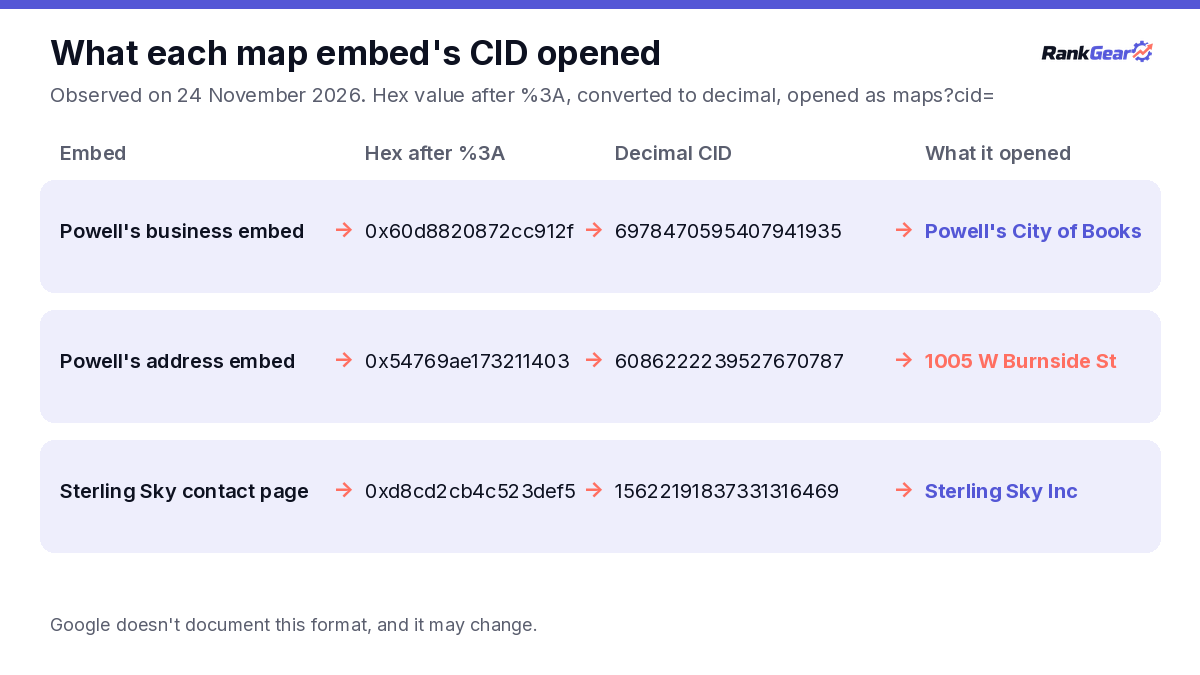
| Embed | Hex after %3A | Decimal CID | What the CID opened |
|---|---|---|---|
| Powell's business embed | 0x60d8820872cc912f | 6978470595407941935 | Powell's City of Books |
| Powell's address embed | 0x54769ae173211403 | 6086222239527670787 | 1005 W Burnside St |
| Sterling Sky contact page | 0xd8cd2cb4c523def5 | 15622191837331316469 | Sterling Sky Inc |
This is what we observed on 24 November 2026. Google doesn't document the pb format or this CID mapping, and it could change.
One reply to Chris asked whether to point the embed "at the cid link or the maps share link" (@anseoagency on X). This article found no public test that compares a profile-tied embed with an address embed for rankings. The difference you can check is where the click goes and what the card shows.
Re-run the check after a move, a rebrand or a duplicate merge. Google says place IDs "may change over time" and that a place ID can become obsolete "if a business closes or moves" (Google Maps Platform). RankGear's glossary entry on place IDs adds that a place ID "says nothing about how that listing ranks."
Swap in a Business Profile embed and lazy-load it
- In Google Maps, search the business name, not the address, and open your listing. Then use Share, "Embed a map" and "Copy HTML" (Google Maps Help). The Share dialog varies. On 24 November 2026 it showed Copy Link, WhatsApp, Gmail and Embed a map. That differs from the layout Chris describes.
- Run the CID check on the new code before you publish it.
- Replace the old iframe. Keep it at least 200 px in both directions. Google says embedded maps "are not supported below a size of 200 px in either dimension" (Maps Embed API).
- Keep
loading="lazy"and add atitleattribute for screen readers. If the map sits above the fold, consider the static-image facade from web.dev instead. - Keep the name, address, phone and hours as text on the page next to the map. Google says profile info comes partly from "crawled web content (e.g., information from a business' official website)" (Google Business Profile Help).
- If you'd rather pin the map by place ID, use the Maps Embed API
placemode withq=place_id:. It needs an API key. - Write down the date and time of the change and which pages changed.
Set up a fair GBP map embed test with controls
The strongest design is a split test across several location pages. Group similar pages by traffic, market and review counts. Pick about half in advance, swap the embed on those, and leave the rest as controls. SearchPilot's method compares variant pages with control pages. Effects from "seasonality, sitewide changes, Google algorithm updates, competitor changes" then hit both groups (SearchPilot). RankGear's write-up on how we run a controlled SEO experiment explains the same rule of changing one thing and holding the rest.
With one location, a before-and-after comparison on a single site is the fallback. That design is weaker because it can show what happened but not why.
For timing, this article suggests at least four weeks of data before the change, then four to eight weeks after. That's an editorial suggestion, not a Google rule. Compare whole weeks with whole weeks so weekdays line up. Google says, "The newest data can be preliminary" (Search Console Help).
Freeze other changes on test and control pages during the window. That means no content rewrites, title changes, new links, review campaigns or edits to the profile's categories, name or hours. Sterling Sky reported that edits to GBP fields such as "the categories, business name, or website field, generally result in an increase in ranking within 48 hours" (Sterling Sky). An edit like that during the window would blur the result. A forum reply makes the same point: when testing, make sure "adding the map is the only change you're making" (Local Search Forum).
Log everything with dates, including the embed change, any edits you couldn't avoid, new reviews, competitors that open or close, and Google updates from the Search Status Dashboard.
Measure each of these three surfaces on its own:
- Map pack and Maps. Rank depends on where the searcher is. Google lists distance as a core factor (Google Business Profile Help), and Whitespark's experts rank proximity second (Whitespark). Check rank from the same fixed coordinates each time. RankGear's Local Grid records where a tracked business ranks, or that it wasn't found, at each point on a grid (defined in the Local Grid glossary). Run it before and after to see observed rank at points in time. It doesn't detect embeds or show why a rank changed.
- Local organic. In Search Console, filter the Performance report to the changed URLs. Compare page-level clicks and impressions for test and control pages. Google says data grouped by Pages "is aggregated by page" (Search Console Help).
- AI results. Google says sites in AI features "are included in the overall search traffic in Search Console" (Google Search Central). Google reports them in the Web search type, and you can't separate them there. If AI visibility matters, record dated manual checks on a fixed list of queries and call them spot checks.
Export GBP Performance metrics for the same windows: website clicks, directions and calls. Google defines website clicks as "the number of times people clicked on the website link on your Business Profile" (Google Business Profile Help). Two cautions come from the same page. Google says performance data "includes views, searches, and actions from both organic search results and Google Ads." Pause or log ad changes for that reason. Google also doesn't say whether a directions request that starts from your website embed counts in the profile's Directions metric. Don't assume it does.
Log these other confounders with dates as well:
- Reviews. Google says, "More reviews and positive ratings can help your business's local ranking" (Google Business Profile Help).
- Core updates. Google recommends "waiting at least a full week after a core update completes before analyzing your site" (Google Search Central).
- Everything else. Searcher location, seasons and holidays, competitor changes and ad activity.
As of 24 November 2026, Search Engine Roundtable listed the November 2026 core update as completed and a December 2026 core update as preannounced (Search Engine Roundtable). A test that overlaps a core update can show ranking moves that have nothing to do with the embed.
Read your GBP map embed test results against a control
Compare test pages with control pages, not after with before. If both groups rose by about the same amount, the rise didn't come from the embed. Then check the result against baseline noise. Look at how much the metric swung week to week before the change. A move inside that range isn't a result.
Then look for consistency across pages and weeks. Did most test pages move the same way, and did the change hold for several weeks? On a Local Grid, did it show at most points or only one?
Keep the map pack, organic results and AI results apart in your report. A local organic change with a flat map pack fits the thin evidence so far. SearchPilot saw a 7% organic drop on removal (SearchPilot), and Sterling Sky's interim note says "The only improvements we have seen are on the organic side" (Local Search Forum). Don't report one surface as the other.
If the log shows a core update, a review surge or a profile edit in the window, say so and call the result inconclusive.
Even a clean before-and-after only shows that the change and the movement happened together. A controlled split test reduces outside causes, and even then the result applies to that site. Report what changed, when, on how many pages, what moved and by how much, against which control, and what else happened in the window. A result of no measurable change is a valid and useful result.
Google Business Profile map embed FAQs
Does a Google Business Profile map embed help local rankings?
There's no evidence it moves the map pack, and the research for this article found no Google statement either way. Sterling Sky's interim test was "very meh," and Whitespark's experts rank the embed 125th of 187 for map pack impact (Whitespark). One controlled test points to a small organic effect.
Should a GBP map embed use the CID link or the Share code?
This article found no public test that compares them for rankings. In our 24 November 2026 test, the Share code from a business listing carried the listing's ID, and the CID link is how you confirm where it leads. See Check which listing your GBP map embed opens.
Does a Google Maps embed need an API key?
You don't need one for the Share code, and the code from our test had no key in it. The Maps Embed API needs a key, and Google says it's "free to use with unlimited requests."
Does a GBP map embed need hasMap in LocalBusiness markup?
Google's LocalBusiness structured data docs list name and address as required, and hasMap isn't on Google's list of properties (Google Search Central).
Can RankGear track a Business Profile embed change?
This article does not claim RankGear detects or scores map embeds. RankGear's Local Grid shows observed map rank at grid points. You can use it to watch rank before and after a change.
Google Business Profile map embed checklist
- The card shows your name, rating and reviews, and the CID opens your business.
- Your name, address, phone and hours are in the page text.
- The map is lazy-loaded, or a facade if it sits above the fold.
- The map is at least 200 px in both directions.
- You re-check the embed after a move, a rebrand or a merge.
- You don't expect map pack movement, and you test it if rankings matter.
Fix the embed because customers click it, and test any ranking claim on your own pages before you repeat it.
Sources
- Chris Simpson on X (23 Nov 2026): https://x.com/ChrisSimpson/status/2125022334667124917
- @TheRizx on X, reply (24 Nov 2026): https://x.com/TheRizx/status/2125242521978871891
- @anseoagency on X, reply (24 Nov 2026): https://x.com/anseoagency/status/2125179282762948783
- Google Maps Help, Share, send, or print directions from Google Maps: https://support.google.com/maps/answer/7101463
- Google Maps Platform, Embed a map (Maps Embed API): https://developers.google.com/maps/documentation/embed/embedding-map
- Google Maps Platform, Maps Embed API usage and billing: https://developers.google.com/maps/documentation/embed/usage-and-billing
- Google Maps Platform, Place IDs: https://developers.google.com/maps/documentation/places/web-service/place-id
- Search Engine Roundtable, Google Business Profile web search interface gains add map to your website (21 Dec 2022): https://www.seroundtable.com/google-add-map-to-your-website-34594.html
- Search Engine Roundtable, Google local ranking docs updates (15 Jul 2025 page, Most Recent Articles sidebar as fetched 24 Nov 2026): https://www.seroundtable.com/google-local-ranking-docs-updates-39761.html
- Phil Rozek, 20 Local SEO Techniques You Overlooked (Almost), Local Visibility System (26 Feb 2015): https://www.localvisibilitysystem.com/2015/02/26/20-local-seo-techniques-you-overlooked-almost/
- Google Business Profile Help, Tips to improve your local ranking on Google: https://support.google.com/business/answer/7091
- Google Business Profile Help, Understand how Google sources and uses info in Business Profiles: https://support.google.com/business/answer/2721884
- Google Business Profile Help, Understand your Business Profile performance and insights: https://support.google.com/business/answer/9918094
- SearchPilot, Are embedded map components sending the right signals for local SEO? (9 May 2025): https://www.searchpilot.com/resources/case-studies/local-seo-embedded-map-component
- Local Search Forum, Embedded GBP map affect rankings? (thread started 15 Jul 2025): https://localsearchforum.com/threads/embedded-gbp-map-affect-rankings.62614/
- Whitespark, 2026 Local Search Ranking Factors, Darren Shaw (6 Nov 2025): https://whitespark.ca/local-search-ranking-factors/
- Sterling Sky, Does geotagging photos influence ranking? Joy Hawkins (15 Jan 2024): https://www.sterlingsky.ca/geotagging-photos-impact-ranking/
- web.dev, Best practices for using third-party embeds (last updated 5 Oct 2021): https://web.dev/articles/embed-best-practices
- Search Console Help, Performance report: https://support.google.com/webmasters/answer/7576553
- Google Search Central, AI features and your website: https://developers.google.com/search/docs/appearance/ai-features
- Google Search Central, Core updates: https://developers.google.com/search/docs/appearance/core-updates
- Google Search Central, LocalBusiness structured data: https://developers.google.com/search/docs/appearance/structured-data/local-business
- RankGear: https://rankgear.com/correlation-vs-causation-in-seo/ , https://rankgear.com/how-we-run-a-controlled-seo-experiment/ , https://rankgear.com/features/local-seo/ , https://rankgear.com/knowledge-base/glossary-local-seo-maps/place-id/ , https://rankgear.com/knowledge-base/glossary-local-seo-maps/local-grid/