
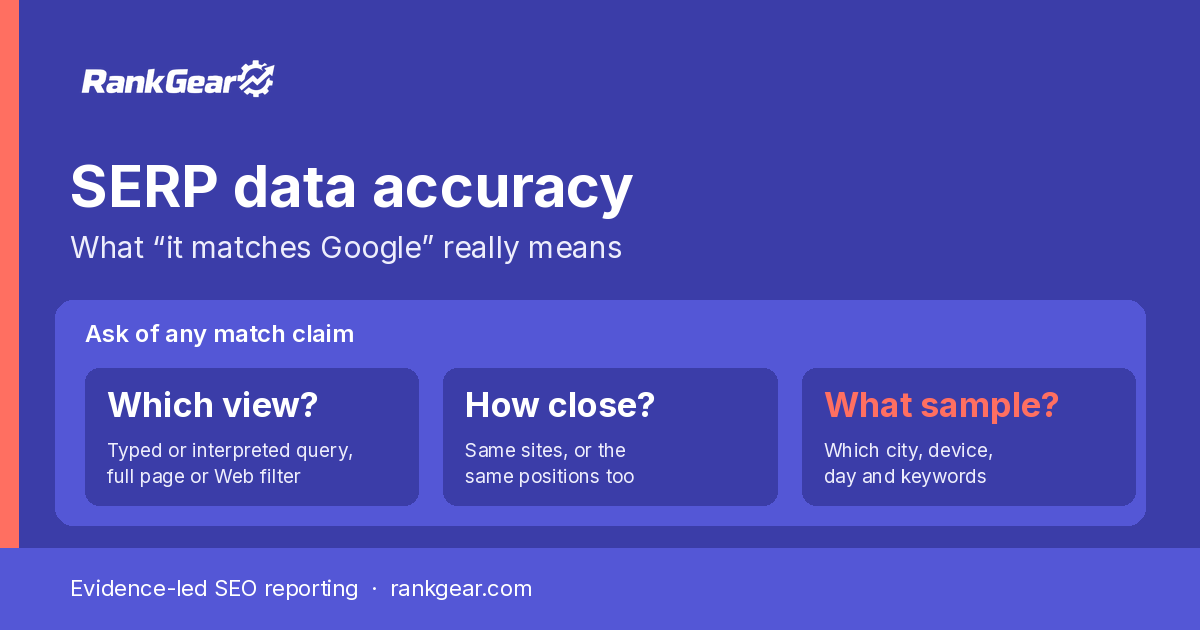
On 18 November 2026 at 5:12 p.m. MST, Phuc Le posted on X that DataForSEO's fix for poisoned Google results matches Cloro, another SERP API (X post). In his test, each page was compared with a manual Google search. With the fix off, "only about 30% of pages looked right." With the fix on, the figure was 100%. As of about 10:05 a.m. MST on 19 November 2026, the post had 240,450 views, and Phuc Le had 1,687 followers.
The next morning, Search Engine Watch and Search Engine Roundtable reported that Google was testing a "Show original results" button for queries it reinterprets (Search Engine Watch, Search Engine Roundtable). Both reports describe the button as part of how Google reads a typed query, and neither ties it to bots or rank trackers.
Both stories show that Google already serves more than one legitimate version of the same search. A claim that a dataset matches Google only tells you something once you know which version was the reference. For background on poisoned results, see our earlier article on poisoned SERPs.
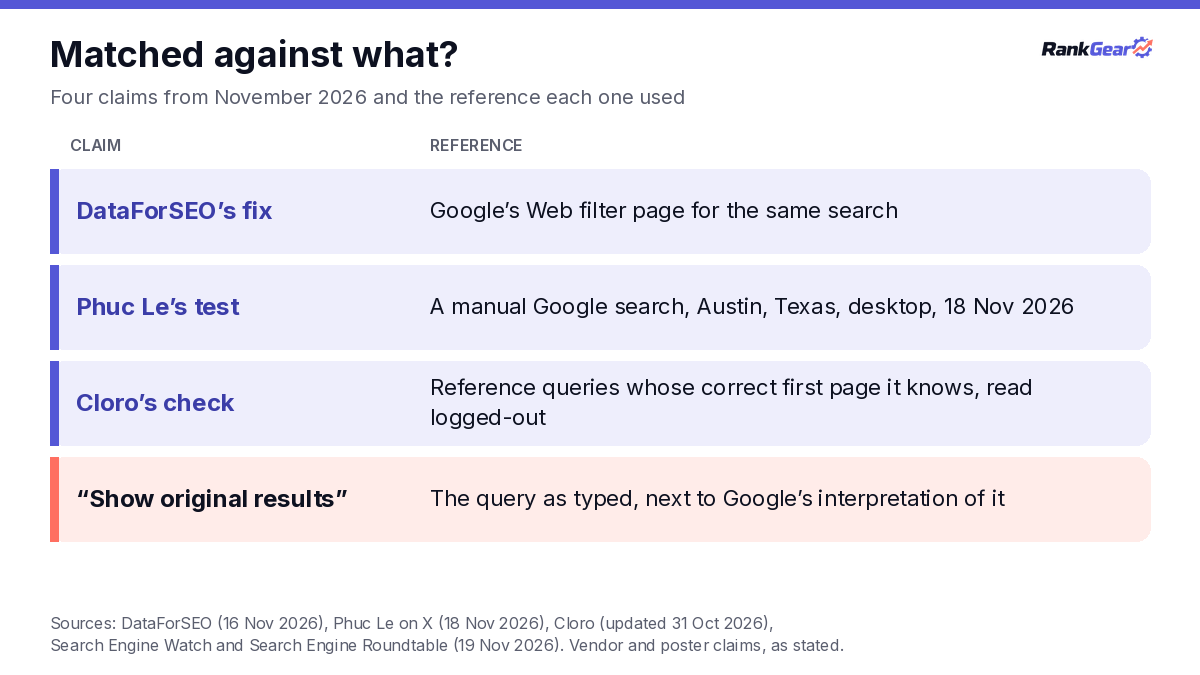
Check how the poisoned results fix compares pages
DataForSEO's fix is a setting on its Google Organic SERP API called resolve_poisoned_results. DataForSEO announced it on 16 November 2026 (DataForSEO update). Its reference is a second Google page for the same search.
How the fix uses the Google Web filter as its reference
DataForSEO says the API "compares its organic results with a reference page retrieved through Google's Web mode." If it detects poisoning, "affected organic listings are replaced with results from the Web-mode page." Restored results carry from_web in their checks array (DataForSEO blog). If poisoning shows up on page one, later pages in the same task are also collected in Web mode. The setting can't be combined with udm=web or udm=14. "If the reference page cannot be retrieved, the API returns the original results unchanged."
The fix adds the cost of one extra SERP page to every task. In DataForSEO's examples, a Standard task at Normal priority goes from $0.0006 to $0.0012. A Standard task at High priority goes from $0.0012 to $0.0024, and a Live task at Normal priority from $0.002 to $0.004. The charge applies "whether poisoned results are detected" or not.
Google's Search Liaison described the Web filter in May 2024 as a filter "that shows only text-based links" (Google SearchLiaison on X). DataForSEO's post, dated 16 November 2026, says that "in our testing, it doesn't return poisoned results." Its reasoning is that when the two pages differ a lot, "one of them is wrong. Evidently, it isn't the Web page." That is DataForSEO's own test and reasoning. This article has not found an independent test of the Web filter.
Check AI Overviews and People Also Ask outside the poisoned results fix
The fix repairs organic listings only, and DataForSEO says the other features stay as fetched: "Other SERP features, including AI Overviews and People Also Ask, are preserved from the original page." Phuc Le's earlier graphic lists the same limit.
Nozzle's research shows those features also change on poisoned SERPs (Nozzle Research). The page is by Derek Perkins, dated 10 October 2026 and updated 3 November 2026, with data through 3 November. Nozzle compares each part of a SERP with the keyword's previous SERP. People Also Ask kept 87.4% of its previous questions at baseline and 26.1% on poisoned SERPs. AI Overview sources kept 68.6% at baseline and 35.8% on poisoned SERPs. Organic results went from 88.2% to 30.0%.
So a page with repaired organic results can still carry AI Overview sources and questions from a poisoned page. If you report on AI Overview citations, check them on their own. Our piece on AI Overview citation volatility covers why those sets move from day to day.
DataForSEO also lists two limits of its own. "What the parameter can't do is repair the past." And "this protection is meant to last as long as the Web search vertical remains unpoisoned." The fix shipped on 16 November 2026, and as of 19 November 2026 it's too early to tell how well it holds up.
Read the cross-check on X as one SERP accuracy test
Phuc Le's post is a useful test to learn from because it names a reference, a match rule and a setting. Those details let you judge what the result covers.
How the test defined accurate SERP data
The graphic on the post defines the result. "'Looked right' = the page kept at least half of the sites a manual Google search showed." It says the test ran on 18 Nov 2026, on desktop, in the United States. It used "Same keywords, same city (Austin, Texas), same day."
The figures, per the graphic, were 30% of pages looking right with the fix off, 100% with the fix on, and 100% for Cloro. It also compared the two providers with each other. "96% of the top-10 sites were the same on DataForSEO (fix on) and Cloro. 78% were at the same position too." The graphic adds, "Exact positions still differ between any two fetches."
Those two figures measure different things, since sharing positions is a stricter test than sharing sites. A page can pass the "at least half of the sites" rule and still list its results in a different order.
Treat one test as a spot check on SERP data accuracy
The test covers one city, one day and one device. Because the keyword count and keyword list aren't published, it works as a spot check, and a helpful one.
Phuc Le's earlier post, on 18 November 2026 at 12:51 a.m. MST, reported a separate test (earlier X post). About 70% of normal fetches looked poisoned. With the fix on, about 95% of pages looked right. "The rest were local searches sent without a city, where every fetch lands in a different town."
A reply in the thread asked a fair question. "curious how often the diff is real spam vs just google shuffling rankings. could flag legit pages too" (reply on X). As of 19 November 2026, we haven't seen a public answer to it.
Phuc Le makes software for SEOs and tested the fix for SEO Utils, and his post tells SEO Utils users how to turn it on. In a reply, he wrote, "I am going to add Cloro as another SERP API to SEO Utils as well" (reply on X). What is public is a business tie to DataForSEO and a planned one to Cloro.
How Cloro goes about verifying SERP data
Cloro is a SERP API vendor, and its post is by founder Ricardo Batista, dated 20 October 2026 and updated 31 October 2026 (Cloro). Cloro says it runs every request logged-out and checks its access to Google using "queries whose correct first page we know." It says "Anything that reads degraded is taken out of service until it reads clean again."
Cloro reports that in the 12 hours to 06:00 UTC on 31 October, it returned the full page on 95.8% of reads of those reference queries. Cloro adds that "95.8% is not a figure for every query a customer sends." It also writes, "No two of these numbers compare directly, ours included." Because its figures come from before DataForSEO's 16 November fix, they don't describe the fix.
Note which original Google results you compared against
Phuc Le's reference was a manual Google search. That search is itself one version of the results. Google offers several, and some of them are built to differ.
Read the Show original results test as query interpretation
Khushal Bherwani wrote in Search Engine Watch on 19 November 2026 that "Google is displaying a 'Show original results' button when users enter random typo characters words in a search query and Google interprets the query to show results based on its understanding." He added, "I'm not sure whether this is a new feature or an existing one."
Barry Schwartz wrote in Search Engine Roundtable at 7:31 a.m. ET (5:31 a.m. MST) the same day. "It seems this button does something similar to the 'Search instead for' link." He also wrote, "I cannot replicate it, I did try the same or a super similar query" (Barry Schwartz on X). The report rests on one screenshot from Khushal Bherwani (Khushal Bherwani on X). As of 19 November 2026, we found no Google statement about the button.
Pick a version of the live SERP before you compare
Google describes other views of the same search. Its Search blog said in November 2011 that Verbatim uses "the literal words you entered" without changes such as spelling corrections or personalization (Google Search blog). As of 19 November 2026, Google's Search Help lists "Verbatim: Search for exact words or phrases" among its search tools (Google Search Help). Google also says "You won't always find every option." The Web filter is another view of the same search, with text links only.
Your typed query and Google's reading of it can show different results. So can the full page and the Web filter, or a logged-in and a logged-out search. Location, device and personalization add more versions, and our poisoned SERPs article covers those. When you say a dataset matches Google, name the version you used.
Verify SERP data yourself with a short routine
Try this on a small set of queries before you trust a provider's data again, and keep your notes for each one.
- Write down your reference first. Note the query as typed, the location, the device, and whether you were logged in. Note whether Google showed "These are results for" or a "Show original results" button (Search Engine Watch).
- Use the provider's check link if it has one. DataForSEO responses include a
check_urlfield. DataForSEO says its documentation recommends opening it "in incognito mode" (DataForSEO, October 2026). It also says that in a regular browser session, "the same search almost never returns a poisoned page." Nozzle's AMA says, "We haven't seen any evidence of poisoning in logged-in results" (Nozzle AMA). Because the two vendors suggest different checks, record which one you used. - Compare sites first, then positions. Phuc Le's test found 96% of sites the same but 78% in the same position. Report the two numbers separately.
- Look past the organic list. Check AI Overview sources and People Also Ask on their own. DataForSEO says those are "preserved from the original page."
- Keep a few reference queries. Cloro suggests queries "whose first page barely changes (a government site, the category leaders)." Check them now and then. Cloro says Google "reshuffled the full page of five of ours, and they stopped telling us anything."
- Cross-check with Search Console. Our earlier article explains how to tell a poisoned SERP from a real ranking drop.
A result that passes these steps is still one sample, and one sample doesn't prove a pattern. Our guide to correlation vs causation in SEO explains why a pattern earns more weight when it repeats across similar queries and over time.
Check SERP data accuracy in your RankGear runs
RankGear measures "the set of pages actually ranking for your exact query" at "your chosen depth (Top 10 to Top 100), country, language, device, and location" (RankGear methodology). Those settings are your reference, and they belong in any comparison you make. Where a feature needs external data, RankGear "uses your provider accounts (SERP, entity, AI)." Each run reflects what your SERP provider returned at run time.
This article does not claim that RankGear detects, filters or corrects poisoned results. Our earlier article explains how we read live SERP samples in RankGear.
To keep a record of what you saw yourself, the free RankGear Browser SERP extension exports a regular Google web search from your own browser to CSV. Its page says results "reflect your browser's session, account and location, not a certified neutral Google ranking." It's a record of one search, and this article does not claim it detects poisoning or verifies any vendor's fix.
SERP data accuracy FAQs
Does the DataForSEO poisoned results fix give accurate SERP data?
DataForSEO says it checks organic results against Google's Web filter page and replaces them if they differ. It doesn't change AI Overviews or People Also Ask. In one public test on 18 November 2026, pages with the fix on matched a manual Google search under the test's own rule. As of 19 November 2026, it's too early to tell how well the fix holds up. See how the fix uses the Google Web filter.
Is the Google Web filter the real original Google result?
It's one of Google's views of the same search. Google says it "shows only text-based links." DataForSEO relies on it because, "in our testing, it doesn't return poisoned results." See pick a version of the live SERP.
Is Show original results related to poisoned SERPs?
No source we found says so. Search Engine Watch describes it as appearing when Google interprets a typed query. Search Engine Roundtable says it seems similar to the "Search instead for" link. There's more in the section on the Show original results test.
Has Google commented on SERP data accuracy for rank trackers?
Not that we found as of 19 November 2026. DataForSEO wrote on 23 October 2026 that Google "has published no official statements regarding this." Semrush wrote on 27 October 2026 that "Google hasn't commented publicly" (Semrush).
Before you trust any claim that a dataset matches Google, write down the Google view, the match rule and the sample, then test a few queries yourself.
Sources
- Phuc Le on X, 18 November 2026, 5:12 p.m. MST (main post and attached graphic). https://x.com/phuclh93/status/2123207856497549345
- Phuc Le on X, 18 November 2026, 12:51 a.m. MST (earlier post and attached graphic). https://x.com/phuclh93/status/2122960886646325733
- Phuc Le on X, reply on pricing and Cloro, 18 November 2026. https://x.com/phuclh93/status/2123252022871019941
- @ismecooper on X, reply, 19 November 2026. https://x.com/ismecooper/status/2123334819866198152
- DataForSEO. Detect and Resolve Poisoned Google Results with DataForSEO SERP API (16 November 2026). https://dataforseo.com/update/detect-and-resolve-poisoned-google-results-with-dataforseo-serp-api
- DataForSEO, George Svash. Poisoned SERPs: The Fix Is Live. Here's How It Works (16 November 2026). https://dataforseo.com/blog/poisoned-serps-the-fix-is-live-heres-how-it-works
- DataForSEO, George Svash. Poisoned SERPs: What's Happening With Google Results and What We're Doing About It (23 October 2026). https://dataforseo.com/blog/poisoned-serps-whats-happening-with-google-results-and-what-were-doing-about-it
- Cloro, Ricardo Batista. Poisoned Google SERPs: what we measured and how we fixed it (20 October 2026, updated 31 October 2026). https://cloro.dev/blog/google-poisoned-serps/
- Nozzle Research, Derek Perkins. Poisoned Google SERPs (10 October 2026, updated 3 November 2026). https://nozzle.io/research/poisoned-google-serps/
- Nozzle. What to Do About Poisoned SERPs: Takeaways From Our Women in Tech SEO AMA (11 November 2026). https://nozzle.io/blog/what-to-do-about-poisoned-serps/
- Search Engine Watch, Khushal Bherwani. Google adds Show original results button for interpreted search queries (19 November 2026). https://searchenginewatch.com/google-adds-show-original-results-button-for-interpreted-search-queries/
- Search Engine Roundtable, Barry Schwartz. Google Search Show Original Results Button (19 November 2026). https://www.seroundtable.com/google-search-show-original-results-button-42574.html
- Barry Schwartz on X, 19 November 2026. https://x.com/rustybrick/status/2123393677150036260
- Khushal Bherwani on X, 19 November 2026. https://x.com/b4k_khushal/status/2123429157283774827
- Google SearchLiaison on X, 14 May 2024. https://x.com/searchliaison/status/1790473952256786805
- Google Search blog. Search using your terms, verbatim (15 November 2011). https://search.googleblog.com/2011/11/search-using-your-terms-verbatim.html
- Google Search Help. Search tools. https://support.google.com/websearch/answer/142143
- Semrush. Poisoned SERPs: An update on Google ranking data in Semrush (27 October 2026). https://www.semrush.com/blog/poisoned-serps/
- RankGear. Poisoned SERPs: why your rank tracker and the live SERP disagree. https://rankgear.com/poisoned-serps/
- RankGear. Methodology. https://rankgear.com/methodology/
- RankGear. Browser SERP extension. https://rankgear.com/browser-extension/
- RankGear. Correlation vs causation in SEO. https://rankgear.com/correlation-vs-causation-in-seo/
- RankGear. AI Overview citation volatility. https://rankgear.com/ai-overview-citation-volatility/