
On 16 November 2026, the X account @borjafat posted "10 Claude commands that do your SEO for you" with a short video (X post). At about 11:25 a.m. MST on 17 November 2026, it had 11,264 views and 275 bookmarks, more views than the account's 7,161 followers. The author's X bio reads "building distribb.io so it grows itself." The author's reply in the thread links to Distribb's listing in Claude's connector directory (Claude directory). It's a useful list to test, so this article walks through what each kind of command can and can't check.
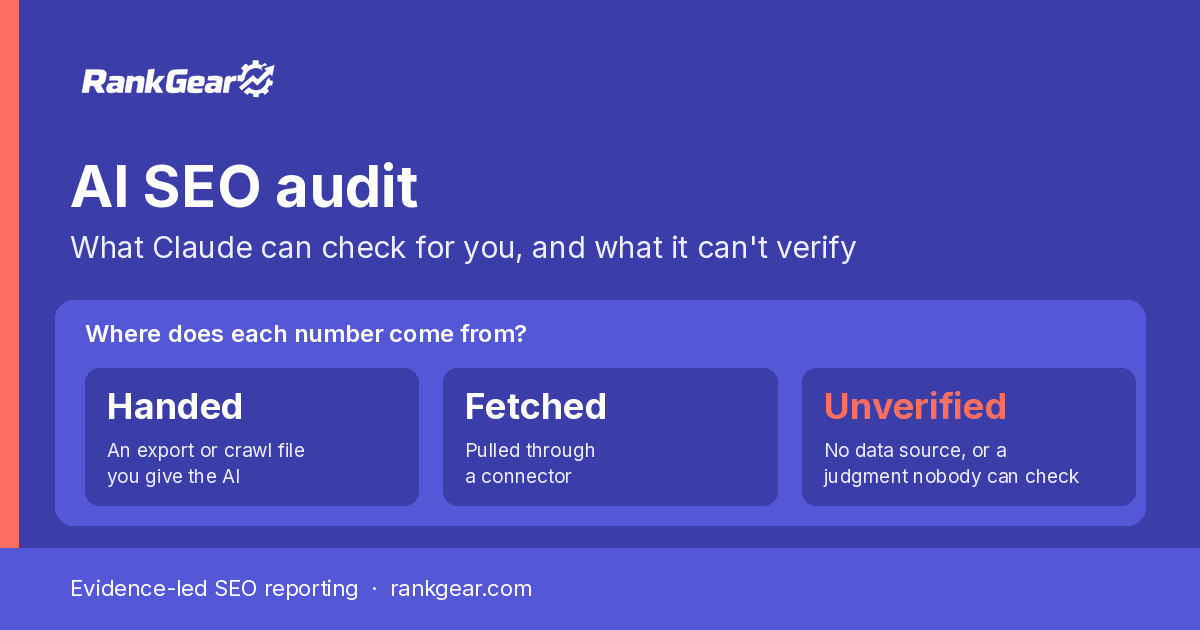
Whether you can trust an AI SEO audit depends on where each number comes from. Some data is handed to the AI, like a Search Console export or a crawl file. Some data has to be fetched through a connector. Some claims have no data behind them at all. Sort each finding by its source before you act on it.
A note from Clint Butler, RankGear
"While AI can assist you in gathering data and finding many basic errors, a business owner should never rely solely on AI for SEO, nor should they blindly assume that all the recommendations or changes AI makes are actually the best thing for your website."
What the ten Claude SEO commands claim
The post lists ten slash commands, quoted here in the author's words:
/gsc-audit: "unlock hidden opportunities in your Google Search Console"/keyword-research: "keywords with real search volume and difficulty"/optimize: "rewrite the pages stuck on page two"/write-article: "research, write and publish an article straight to your site"/backlinks: "check the backlinks real businesses are giving you"/link-building: "a give-first outreach play, right up to a ready-to-send email"/gov-backlinks: "free backlinks from government directories"/ai-visibility: "find where ChatGPT should be recommending you"/statistics-page-writer: "a stats page made for journalists to cite"/news-writer: "turn fresh news in your niche into articles"
Where an AI-run SEO audit gets each number
Every finding in an AI-run SEO audit comes from one of three places. Anthropic's help center says custom connectors "let you connect Claude directly to the tools and data sources" in your workflow (Anthropic help center). Once connected, "Claude can access those services and take action in them." The same page says connectors can include services "that haven't been verified by Anthropic." What Claude can check depends on what its connector actually fetched.
- Handed data: a Search Console export or a crawl file you give the AI. A model can read and sort it well. Ullrich's test, covered below, shows it can slip when it turns a number into a diagnosis.
- Fetched data: search volume, difficulty, backlinks and live rankings pulled through a connector. The answer is only as good as the source behind it. Without a source, the model is estimating.
- Unverifiable judgments: a claim that a rewrite will lift a page off page two, or that a page is thin. Nobody can check those ahead of time. They need the live SERP and a before-and-after measurement.
| Command | What it needs | Where the answer comes from |
|---|---|---|
/gsc-audit | A Search Console export or connection | Handed data, if the export is real |
/keyword-research | Volume and difficulty figures | Fetched data. The post names no provider |
/optimize | Current rankings and a rewrite | Fetched data plus an unverifiable judgment |
/write-article | Research, a draft and a publish step | Generated text. Google says it needs a manual fact-check first |
/backlinks | Backlink data | Fetched data |
/link-building | Prospect data and an outreach email | Fetched data plus judgment |
/gov-backlinks | Not described beyond the one line | Unclear from the post |
/ai-visibility | Answers from AI tools | Fetched data |
/statistics-page-writer | Statistics with sources | Fetched data. Every figure needs a source check |
/news-writer | Fresh news in your niche | Fetched data. Every claim needs a source check |
This sorting is our reading of the one-line descriptions in the post. It is not a test of the commands.
What an SEO audit with AI does well
Given real data, an AI is good at sorting it and spotting patterns. Google says "Generative AI can be particularly useful when researching a topic, and to add structure to original content" (Google Search Central).
Reading Search Console exports with AI SEO tools
An AI can read a Search Console export quickly and group queries, pages and trends. It is reading Google's sample, though, and that sample has gaps. Google says anonymized queries, which "aren't issued by more than a few dozen users over a two-to-three month period," are left out of the tables (Google Search Central). The Search Console interface exports a maximum of 1,000 rows. The API returns up to 50,000 rows per day per site per search type. Ask the AI which export it read and how many rows it had before you trust its "hidden opportunities."
Basic errors a Claude SEO audit can catch from a crawl
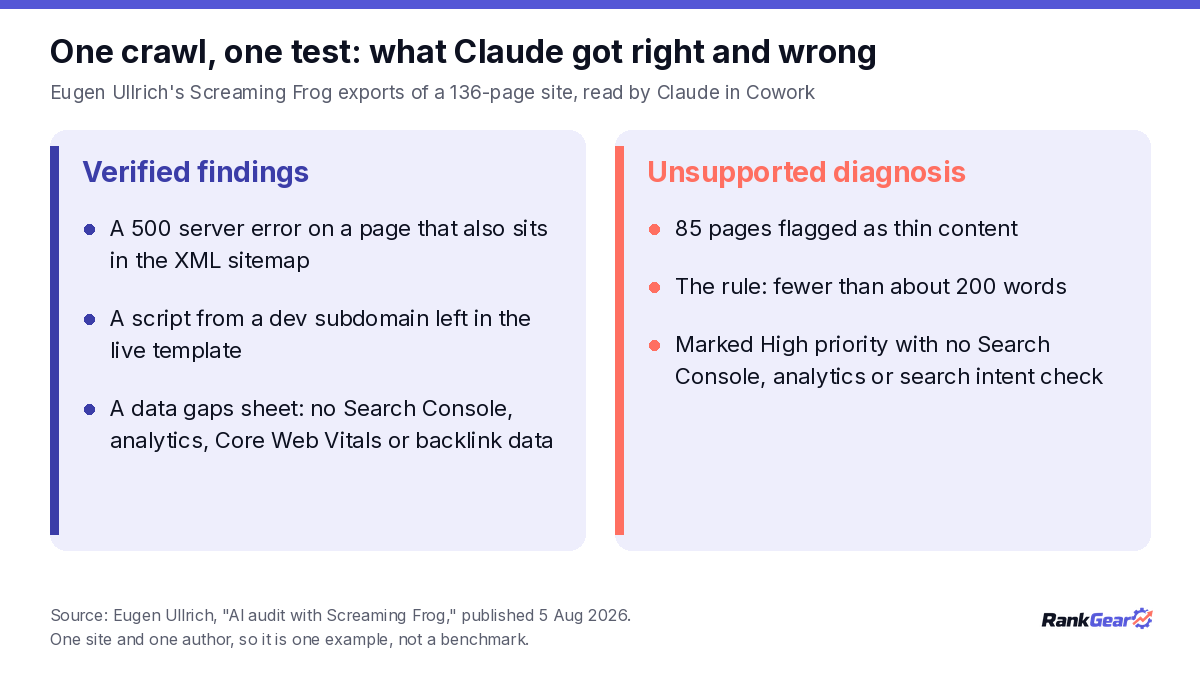
A Claude SEO audit can find real technical errors when it works from a real crawl. Eugen Ullrich fed Screaming Frog exports for a 136-page site into Claude in Cowork and published the results on 5 August 2026 (Eugen Ullrich). Claude found "a 500 server error on a page that also sits in the XML sitemap." It also found a script from a dev subdomain left in the live template. Ullrich writes, "Both are concrete, verifiable findings." Claude even built its own "data gaps" sheet, which noted there was no Search Console, analytics, Core Web Vitals or backlink data. Treat it as one example, since Ullrich tested a single site.
Aergos, an agency that sells its own audit platform, says AI tools "aren't useless" for content gap analysis, keyword clustering and first-draft briefs (Aergos). Give the AI a real crawl from your own crawler, and keep the crawl file next to the findings.
What AI SEO audits cannot verify on their own
Three kinds of findings need outside proof: search volume, diagnoses and anything about the live SERP. As of 17 November 2026, we found no large independent benchmark of AI SEO audit accuracy. The tests that exist come from practitioners and vendors, and each has its own sample size and date.
Search volume numbers from AI SEO tools
In a post dated 19 May 2025, DEJAN compared Google Gemini's volume predictions with Search Console data from its own property (DEJAN). Correlation was weak to moderate, with Pearson at about 0.41 and Spearman at about 0.57. With volumes sorted into five buckets, "Only 35% of predictions landed in the same bucket as reality." DEJAN asks whether an LLM can "accurately estimate query search volumes" and answers no, though it says the model has "a general idea" of them.
Adomas Šulcas ran a quick test on one client's keywords and posted it on LinkedIn on 26 October 2025 (Adomas Šulcas on LinkedIn). He found that LLM estimates averaged 851% deviation from the consensus of Ahrefs and Semrush. He calls the analysis hasty and recommends "taking it with a grain of salt." With a single client's keyword list, it is a small sample.
"Real search volume" is only real when it comes from a named data provider. Ask the tool to name the provider for every volume figure.
Invented diagnoses in AI audit findings
In Ullrich's test, Claude flagged 85 pages under about 200 words as "thin content" and marked them High priority (Eugen Ullrich). Ullrich writes, "It backed that up with nothing." Google's helpful-content page asks if you are writing to a word count because you heard Google prefers one, and it answers "(No, we don't.)" (Google Search Central). Ullrich also ran the same crawl through a second model, which he labels Gemini. He says "both name the same numbers and both fail at the interpretation." His conclusion is that the review layer "belongs to a human."
Aergos describes a similar pattern in "100 Client-Submitted AI Audits," published 17 June 2026 (Aergos). It reports ranking positions with "no data source," and pages flagged as 404 errors that actually return 200. "The error was hallucinated," Aergos writes. It also lists schema advice that conflicts with Google's guidelines and Core Web Vitals advice made without field data. Aergos gives no counts for each pattern, and these are one agency's observations. Re-check every status code, schema change and speed claim with a real tool before you assign the work.
Average position in AI audit findings versus the live SERP
A "stuck on page two" claim usually comes from Search Console's average position. Google says that position is "the topmost position occupied by a link to your property or page in search results, averaged across all queries in which your property appeared" (Google Search Console Help). Google also says a position "is not recorded" when the result gets no impression. An AI reading Search Console sees an average. It does not see the current SERP or who outranks you. Live SERP data from automated tools needs its own check, as our post on poisoned SERPs explains. Pull the live SERP yourself before you rewrite a page for a page-two claim.
Confident wrong answers in AI SEO recommendations
AI tools can sound sure and still be wrong. In a study published in March 2025, Columbia's Tow Center tested eight AI search tools with 1,600 queries (Tow Center, Columbia Journalism Review). Each query asked a tool to identify a news article from an excerpt. Together the tools "provided incorrect answers to more than 60 percent of queries." Error rates ranged from 37% for Perplexity to 94% for Grok 3, and the tools "fabricated links." This study tested news citations, not SEO audits. It shows a pattern of confident errors, and it is not an SEO error rate.
Anthropic's Claude docs say, "Even the most advanced language models, such as Claude, can sometimes generate text that is factually incorrect or inconsistent with the given context" (Anthropic docs). Anthropic recommends letting the model say "I don't know," grounding answers in direct quotes and checking claims with citations.
NP Digital surveyed 565 U.S. marketers for a study published 3 February 2026 (NP Digital). It says 47.1% run into AI inaccuracies several times a week, and 36.5% say hallucinated or incorrect AI content has gone live publicly. In its 600-prompt test, NP Digital says recently updated topics and SEO questions caused problems. Ask the AI to quote the source line behind each recommendation, and mark any finding without one as unverified.
What Google says about acting on AI SEO recommendations
Reviewing AI SEO recommendations before you publish
Google says AI output needs a human fact-check before it goes live. Its page on generative AI content, last updated 1 October 2026, says "generative models don't retrieve facts, but predict a likely sequence of words based on their training data" (Google Search Central). It adds, "It is critical to manually factcheck and review all AI-generated content for accuracy and trustworthiness before publishing." Google says the review also applies to metadata like title elements, meta descriptions, structured data and image alt text. That covers /write-article, which promises to publish "straight to your site," and /optimize, which rewrites pages.
Google's helpful-content page, last updated 5 October 2026, says "using generative AI to produce large amounts of text without manual oversight or curation represents little to no effort" (Google Search Central). The generative AI page says using these tools "to generate many pages without adding value for users may violate Google's spam policy on scaled content abuse." Our Monid SEO case study covers that policy in more detail.
Glenn Gabe documented an extreme case on 20 April 2026. He says National Today's /us/ directory "had over 850K urls indexed" of "100% AI-generated local news articles." He says it was removed after a "Scaled content abuse" manual action (Glenn Gabe, GSQI). Google told Futurism, "Our policies prohibit producing content at scale for the primary purpose of manipulating search rankings" (Futurism). That case was mass publishing, and it is not evidence that any one Claude command hurts a site. Keep a person between every AI draft and the publish button.
Link exchanges and AI SEO tools
Two of the commands, /backlinks and /link-building, deal with links. Before you automate link building with any tool, it helps to know where Google draws the line.
Google's spam policy, last updated 28 August 2026, lists examples of link spam (Google spam policies). They include excessive link exchanges ("Link to me and I'll link to you") and "Using automated programs or services to create links to your site."
If a tool or vendor offers automated links or a link network, ask how the links are placed and check that against Google's examples before you sign up.
How to check an AI SEO audit before you act on it
Run each finding through six checks before anyone changes a page.
- Name the data source for every number. If the tool cannot show one, mark the number unverified.
- Re-fetch any status code yourself with a crawler or a browser.
- Pull the live SERP for any page-two claim, and compare it with Search Console.
- Measure before and after each change, on the same queries.
- Never let an AI tool publish on its own. Google says AI content and metadata need a manual fact-check first.
- Keep a change log with the date, the page and the reason for each change.
A ranking change after an AI rewrite is a timing association. It could come from the rewrite, a SERP shift or an update, and correlation does not prove causation. A before-and-after measurement on the same queries helps you tell those apart.
Using AI SEO tools with measurement first
RankGear is one example of the measure-first, interpret-second pattern this evidence points to. Its methodology page says RankGear "measures correlation between on-page factors and live SERP position across the field for your query" (RankGear methodology). The same page says AI interpretation is optional and "always labeled for review," and that it never becomes the measurement.
RankGear's Action Planner reads one saved workbook and uses Claude, OpenAI or Gemini on your own API key. Its page says, "Action Planner does not fetch your page. It does not fetch the ranked competitors." It also says, "Everything it proposes is traceable to a cell in the workbook you selected." RankGear validates the factor and the values the model returns against that workbook, and the page states "Correlation, not causation." This article does not claim that RankGear catches AI errors in general, or that any plan will move a ranking. Whatever tool you use, ask it to show the measurement behind each recommendation.
AI SEO audit FAQs
Can Claude run an AI SEO audit?
Yes, for the parts with real data behind them. In Ullrich's one-site test, Claude read a crawl well and found real errors, then flagged "thin content" with no evidence. Give it real exports and check every diagnosis. See Basic errors a Claude SEO audit can catch from a crawl.
Does Google penalize content from AI SEO tools?
Google says generative AI "can be particularly useful" for research and structure. It also says generating many pages without adding value "may violate Google's spam policy on scaled content abuse," and that AI content needs a manual fact-check before publishing. See Reviewing AI SEO recommendations before you publish.
Can an AI SEO audit replace a crawler?
No. An AI can only check the status codes and links that a crawl or fetch actually returned. Aergos reports AI audits that flagged 404s on pages that return 200. Run a real crawler and give the AI its exports. See Invented diagnoses in AI audit findings.
Is keyword volume from AI SEO tools accurate?
Only when it comes from a connected data provider. In DEJAN's test, only 35% of Gemini's estimates landed in the right volume bucket. Šulcas found an 851% average deviation in a small test on one client's keywords. See Search volume numbers from AI SEO tools.
Who is behind the Claude SEO commands post?
The author, @borjafat, says in his X bio that he is building Distribb, and his thread reply links to Distribb's Claude connector. See What the ten Claude SEO commands claim.
As Clint's note says, use AI to gather data and catch basic errors, and have a person review every change before it ships.
Sources
- @borjafat on X. 10 Claude commands that do your SEO for you (16 November 2026). https://x.com/borjafat/status/2122442101854007731
- Claude directory. Distribb listing (did not render as of 17 November 2026). https://claude.ai/directory/distribb
- Anthropic Help Center. Get started with custom connectors using remote MCP. https://support.claude.com/en/articles/11175166-get-started-with-custom-connectors-using-remote-mcp
- Anthropic. Reduce hallucinations (Claude Platform Docs, undated). https://platform.claude.com/docs/en/test-and-evaluate/strengthen-guardrails/reduce-hallucinations
- Google Search Central. Google Search's guidance on using generative AI content on your website (last updated 1 October 2026). https://developers.google.com/search/docs/fundamentals/using-gen-ai-content
- Google Search Central. Creating helpful, reliable, people-first content (last updated 5 October 2026). https://developers.google.com/search/docs/fundamentals/creating-helpful-content
- Google Search Central. Spam policies for Google web search (last updated 28 August 2026). https://developers.google.com/search/docs/essentials/spam-policies
- Google Search Central Blog. A deep dive into Search Console performance data filtering and limits (October 2022). https://developers.google.com/search/blog/2022/10/performance-data-deep-dive
- Google Search Console Help. What are impressions, position, and clicks? https://support.google.com/webmasters/answer/7042828
- Eugen Ullrich. AI audit with Screaming Frog: Claude reads the data cleanly and invents the diagnosis (5 August 2026). https://eullrich.com/en/blog/ai-seo-audit-claude-screaming-frog/
- Aergos. What 100 Client-Submitted AI Audits Taught Us About LLM SEO Tools (17 June 2026). https://www.aergos.ai/blog/what-client-ai-audits-taught-us
- DEJAN. LLM-Based Search Volume Prediction (19 May 2025). https://dejan.ai/blog/llm-search-volume/
- Adomas Šulcas on LinkedIn (26 October 2025). https://www.linkedin.com/posts/adomas-sulcas_so-apparently-there-are-still-plenty-of-activity-7388222036718010368-dN2g
- Tow Center for Digital Journalism, Columbia Journalism Review. AI Search Has a Citation Problem (6 March 2025). https://www.cjr.org/tow_center/we-compared-eight-ai-search-engines-theyre-all-bad-at-citing-news.php
- NP Digital / Neil Patel. AI Hallucination and Accuracy: A Data-Backed Study (dated 3 February 2026 in page metadata). https://neilpatel.com/blog/ai-hallucination-data-study/
- Glenn Gabe, GSQI. When "Mt. AI" crumbles, ChatGPT can follow (20 April 2026). https://www.gsqi.com/marketing-blog/when-mt-ai-crumbles-chatgpt-follows/
- Futurism. Operator of Slop Farm That Plagiarizes Local Journalism Boasts That It's Attracting Millions of Readers (17 April 2026). https://futurism.com/artificial-intelligence/national-today-ai-plagiarizing
- RankGear. Methodology. https://rankgear.com/methodology/
- RankGear. Action Planner. https://rankgear.com/features/action-planner/
- RankGear. Monid SEO case study. https://rankgear.com/monid-seo-case-study/
- RankGear. Poisoned SERPs. https://rankgear.com/poisoned-serps/