
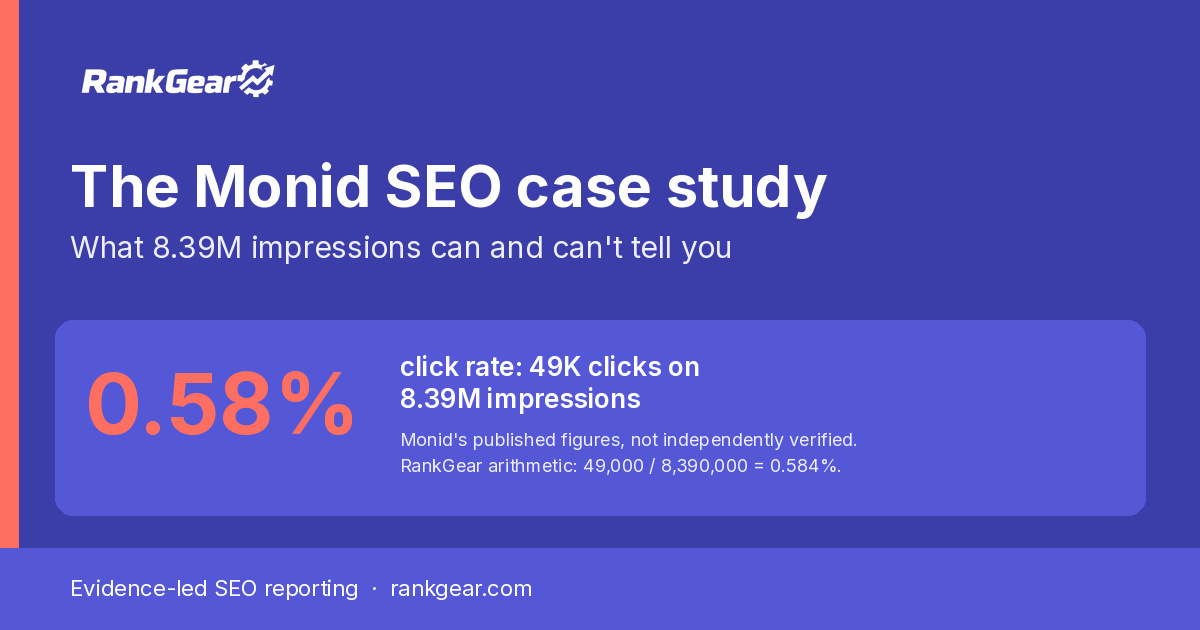
On 12 November 2026, Monid published an X Article called "How to run your SEO from 0 to 8M (step-by-step guide)." It says an unnamed Monid user went from "near zero in May" to "8.39M impressions and 49K clicks by November," with an agent running the SEO loop. Within about an hour, a dozen creator accounts were repeating the same numbers. Some of your clients will forward those posts and ask why they still pay for SEO.
Monid is a real piece of agent infrastructure that SEO consultants, agencies, in-house teams and content strategists may well use. The case study, as published, can't tell you whether an agent caused the growth, and the math below shows what it can and can't support.
What is Monid? The MCP data layer behind the claim
Monid describes itself as "OpenRouter for agent tools" (Monid on X). In plain terms, it is a marketplace and payment layer for AI agents such as Claude or ChatGPT. An agent connects once and searches a catalog of third-party data tools. It checks each tool's inputs and price, runs it, and pays per call from one balance (Monid docs). Monid does not write content or rank anything by itself, because the model and the workflow you build on top do that work.
Monid sells per-call access to the same kinds of SEO data many teams buy through monthly subscriptions. For a consultant or a small in-house team, that could change what the data stack costs. The viral claim built on Monid is also aimed at agencies. One of the first posts to repeat it opened with "SEO agencies are not gonna like this one" (post on X), and clients will ask you about it.
How Monid works with Claude and other AI agents
Agents reach Monid through a remote MCP server at https://mcp.monid.ai/v1. Monid says it works with "Claude.ai, ChatGPT, or any MCP-compatible AI client" (Monid docs). There is also a skill file, a command-line tool, an HTTP API and OAuth (MCP quickstart). The flow is discover, inspect, then run. Monid's plugin repo lists tools such as monid_discover, monid_inspect and monid_run, and says "Discovery and inspection are free. Only monid_run spends workspace balance" (Monid plugins on GitHub).
On pricing, Zongrong Li, who runs growth at Monid, told AgenticFeed that Monid "no longer charges a platform fee," as reported by AgenticFeed. Forkast reported that failed calls cost nothing. The homepage headline is "We killed the subscriptions" (monid.ai).
Monid's SEO data: SERPs, keywords, backlinks and AI answers
Monid's homepage claims "2,800+ tools across 90+ providers," including "Ahrefs SEO data" (monid.ai). Its DataForSEO page lists "216 endpoints from $0.00015/call." They cover live SERPs, keyword volume and difficulty, ranked keywords, backlinks, on-page audits, and "brand mentions inside ChatGPT, Gemini, and Perplexity answers."
Monid supplies the data, while the "SEO" in any Monid workflow comes from the model, the prompts and the people who review the output. That's why it is more accurate to call Monid a general data and tool marketplace that includes SEO data providers than an SEO tool.
Who is behind Monid
Monid is a San Francisco startup with Shengkun Ye as CEO, per AgenticFeed, and Feiyou Guo as a co-founder, per his LinkedIn post. Monid launched in April 2026 with about 200 tools, as Dealroom reported and AgenticFeed cited. Its GitHub organization was created on 3 April 2026 (GitHub API).
The SaaS News reported a $2.1M pre-seed in September 2026. Ye announced a $7.7M seed led by Long Journey on 6 October 2026 (Shengkun Ye on LinkedIn). The core code, monid-ai/monid, is MIT-licensed and had 6,199 GitHub stars as of 15 November 2026 (GitHub API).
Ye's funding post names SEO as a use case: "Agents are already using us to automate SEO, find sales leads, monitor ecommerce markets." Li also publishes an MIT agent-seo-kit of four Claude Code skills, where "One Monid key powers the whole data layer."
What the Monid SEO claim means for agencies and in-house teams
Agencies will get the "why are we paying you?" question, and the best answer is calm and has numbers in it. In-house teams and content strategists face a quieter version: a leader sees "8M" and asks why your program can't do the same with an agent.
Monid itself is worth a fair look, since per-call SERP, keyword, backlink and AI-answer data may cut costs for consultants who don't want five subscriptions. The case study is a separate question. When a client forwards the posts, judge the tool and the claim on their own terms, and start with the evidence behind the claim.
The Monid impressions claim, exactly as published
Monid's X Article went live at 1:28 p.m. America/Phoenix on 12 November 2026 (X Article). It says: "A Monid user shared this with us: near zero in May, 8.39M impressions and 49K clicks by November." It goes on with "About 100K impressions a day now," then "No SEO hire," "No agency," "No retainer," and "An agent ran the loop." The article discloses Monid's interest: "(context: we built it, it's a pay-per-call tool store for agents)." The user and the site are not named.
Less than two minutes later, at 1:29 p.m., Shengkun Ye posted a shorter version: "Claude + Monid = 8M+ impressions 🤯 … A Monid user let an agent run his entire SEO loop. Six months in: 49K clicks from search, about 100K impressions a day." His bio says he is "building @MonidHQ," and the post text doesn't mention the tie.
When RankGear's researcher read the article text through X's API on 13 November 2026, it carried two bracketed notes next to the case-study lines. One read "[verify: his words and permission, see checklist]." The other read "[verify: confirm with the user how he ran it before publishing this sentence]." That version also said, "The 49K clicks are the part you can spend." Monid's own text flagged these lines as unconfirmed. The public page text we loaded on 15 November 2026 does not show those notes or that line, and we don't know whether that means the details were confirmed. If a client leans on this case study, ask Monid for the site name and a raw export before you compare results.
How the Monid SEO claim spread on X
Ye's post had 63,483 views when RankGear checked it on 15 November 2026. At least 12 quote posts and one word-for-word copy followed within about 55 minutes, according to RankGear's X search that day. They reused the same figures and stock phrases, such as "$528/mo," "under $1/day in data," and "checks it like a crawler." Three of the posters work at Monid, per their bios: Ye, Guo and Li.
No post we read carried #ad or a sponsorship line. X's paid-partnership flag was false on every post where X returned that field. Whether any creator was paid or coordinated can't be verified, and we make no claim about it. The "$528" figure is Monid's own tool-stack comparison: "a rank tracker at $129 and an AI visibility tracker at $399," with no vendors named. We could not find "under $1/day in data" in the article text, and it stays unverified.
Reading the Search Console screenshot behind the Monid SEO case study
The evidence offered is a 6-second animated graphic styled as a Search Console Performance report (GIF file). It shows "Search type: Web," a custom date range and a daily chart from 5/10/26, with the last axis label at 10/22/26. The final frame reads 49K total clicks, 8.39M total impressions, 0.6% average CTR and 6.9 average position. The property name and the queries table are blurred.
The totals count up across the frames, from 336 clicks and 4K impressions to 49K and 8.39M. Average CTR stays at 0.6% and average position stays at 6.9 in every frame. But 336 divided by 4,000 is 8.4%, so the early frames can't be real Search Console states. That points to a produced animation built on the final numbers. That does not show the final numbers are wrong. It does mean nobody outside can check the graphic against a live account.
Impressions vs clicks: the CTR math
Using Monid's own figures, 49,000 clicks divided by 8,390,000 impressions is a 0.584% CTR. Allowing for rounding in "49K" and "8.39M," the range is about 0.578% to 0.590%. That matches the 0.6% on screen and means fewer than 6 clicks per 1,000 impressions.
Spread over the charted window of about 165 to 170 days, 8.39M impressions is about 50K impressions a day on average. That fits a curve that started near zero and ended near 100K a day. The 49K clicks work out to about 290 clicks a day on average. No conversion or revenue data was shared. Clicks are the part a business can use, and they are the first number to ask about.
A 0.6% CTR at an average position of 6.9 looks like a low click rate for a page-one average. That is our reading, since we have no sourced benchmark to compare it with. Because average position is weighted by impressions, a site-wide 0.6% CTR can come from many long-tail or informational queries, from surfaces where people rarely click, or from a few queries with huge impression counts. Without the query table, it's too early to tell which. Ask for the query and page breakdown before anyone treats 8.39M as success.
What Search Console impressions include now
Google's Search Console help says an impression "means that a user has seen (or potentially seen) a link to your site." Google says it is generally counted when the item is on the current results page "whether or not the item is scrolled into view" (Search Console help). The same page says AI Overview links follow "standard impression rules," and "an AI Overview occupies a single position in search results, and all links in the AI Overview are assigned that same position."
Google's AI features page says sites that appear in AI Overviews and AI Mode "are included in the overall search traffic in Search Console" within the Web search type. So, per Google, a Web impressions total like the one in the graphic includes AI Overview and AI Mode appearances. It counts how often a link was shown and says nothing about whether anyone read or clicked it.
Impressions are also the metric Google has had to correct. Google's data anomalies page says a logging error affected impressions "from May 13, 2025 until April 27, 2026," and that "clicks were not affected." That fix came before Monid's chart starts, so it does not explain these numbers. Google also reports a separate logging error in the Generative AI performance report for 9 to 11 November 2026, which is a different report and falls after the chart ends. If you are reading any Search Console screenshot this month, our November 2026 core update guide covers the core update and holiday timing that can skew comparisons.
Why an AI SEO case study like this can't show cause
This is one unnamed site, published by the vendor, with no baseline and no control. A curve that rose after an agent loop started is a timing association. Without a named site, nobody can separate the loop from domain age, links, seasonality, Google updates, a migration, PR, paid traffic or other work. Our guide to correlation vs causation in SEO explains why a rise that starts after a change is a lead to investigate and does not prove cause.
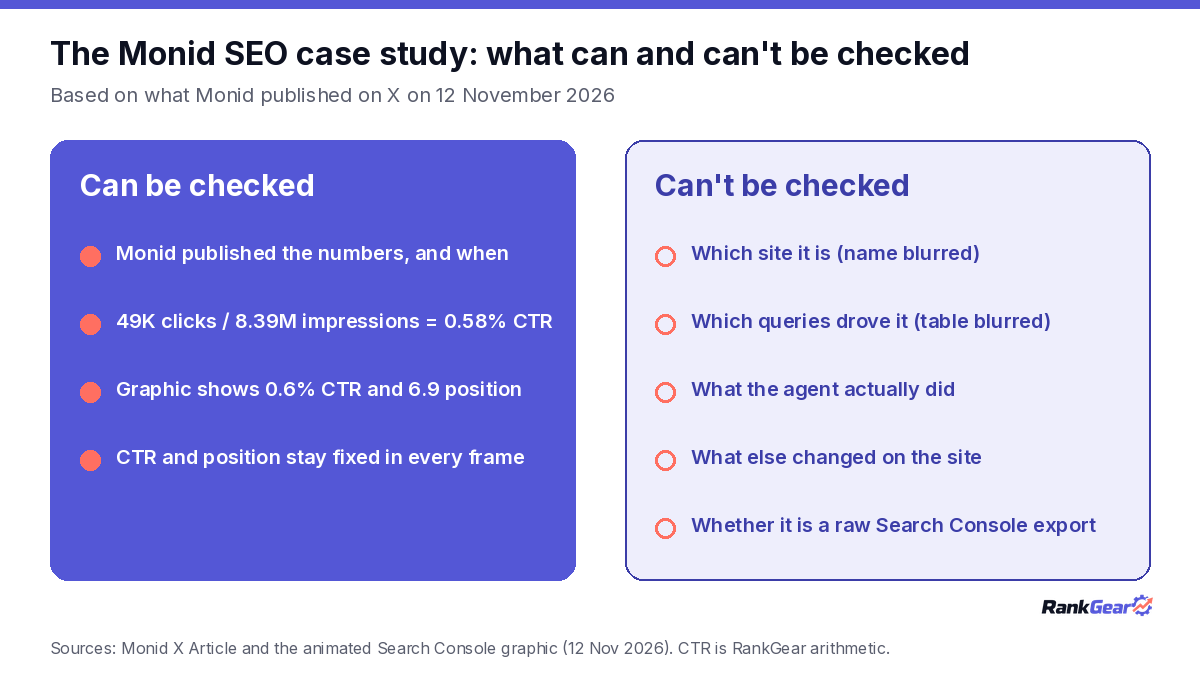
What can be verified is that Monid published these numbers, when it did, and the arithmetic. What can't be verified is the site, the queries, the user, what the agent did, whether anything else changed, and whether the numbers came from a real Search Console export. It's too early to tell whether the loop, or something else, drove the curve.
What a fair test of an agent-run SEO loop would look like
A fair test changes one thing: a set of pages goes on the agent loop while a matched control set stays on your normal process. Record a pre-period baseline for both sets before the loop starts. Then re-measure the same SERPs and the same Search Console clicks over the same windows. Our post on how we run a controlled SEO experiment walks through the setup.
Scaled AI content and agent-run SEO: what Google says
Google's spam policies say "Scaled content abuse is when many pages are generated for the primary purpose of manipulating search rankings and not helping users." One example Google gives is "Using generative AI tools or other similar tools to generate many pages without adding value for users." Google's generative AI guidance says doing that "may violate Google's spam policy on scaled content abuse." It adds that "it is critical to manually factcheck and review all AI-generated content for accuracy and trustworthiness before publishing."
Google's spam policy says it applies to scaled content "no matter how it's created," and it judges purpose and value. We can't see the Monid user's site and make no claim about it. Monid's article describes its own loop as a cron job that "writes three posts" every day. Any team that ships at that pace has to show that each page adds value, because Google says it makes that call and a traffic graph alone can't settle it.
What the Monid and Claude SEO workflow gets right
Several of the prompts in Monid's article match evidence-led SEO. One says, "A volume or KD you did not get from a tool is not a number, write 'not checked' instead." Another says, "Every number comes from a run you did or a page you fetched today." The audit prompt says, "Audit only, change nothing," and "Wait for my yes before any change." The keyword advice reads intent from the live results: "Google already ran the intent test for you. Search the keyword and look at what ranks."
These match RankGear's view: measure against the actual SERP, and put evidence before advice. The gap is that the case study does not meet the same "no number without a source" bar its own prompts set for the agent.
Questions to ask before you trust any AI SEO case study
When a client or a leader forwards a case study like this one, work through these questions.
- Is the site named, and can you see it?
- Does it show clicks, conversions or revenue, or only impressions?
- Is there a query and page breakdown, with brand and non-brand split out?
- What search type and date range does it use, and did a Google update or Search Console data anomaly fall in that window?
- What else changed, such as domain age, links, a migration, PR or paid traffic?
- Is there a baseline and a control?
- Who published it, what do they sell, and do the posts that spread it disclose any ties?
- Is it a raw export or a produced graphic?
- Has anyone measured it against the live SERP for the target queries?
How to evaluate Monid and other AI agent SEO tools for your own team
Start with a small pilot that puts a limited page set on the agent workflow and holds out a matched set. Measure both against the actual SERP and against Search Console clicks over the same windows. Keep a human review step before anything is published, as Google's guidance asks. Track the cost per call against measured outcomes such as clicks and conversions.
For the measuring, a RankGear Analysis Run captures the pages winning a query when you run it. Repeat the same analysis over time. Diff shows baseline and current changes, Trends shows multi-run history, and Volatility shows the query's normal movement range. Together they help you know the difference between progress and noise. You end up with a record you can show a client in place of a single screenshot. See what actually ranks before you change anything a vendor case study suggests.
AI SEO case study FAQs
Is Monid an SEO tool?
Not exactly. Monid is a general data and tool marketplace for AI agents that includes SEO data providers such as DataForSEO and Ahrefs (monid.ai). It supplies data per call, and the model and your workflow do the SEO work. See What is Monid? The MCP data layer behind the claim.
Has the published impressions claim been verified?
No. Monid published the numbers, and the arithmetic checks out, but the site, the queries, the user and the method are not public (X Article). The graphic is a produced animation that nobody outside can match to a live account. See The Monid impressions claim, exactly as published.
Why is this SEO CTR worth asking about?
49,000 clicks on 8,390,000 impressions is a 0.584% CTR, fewer than 6 clicks per 1,000 impressions, at an average position of 6.9. That pattern can come from long-tail queries, low-click surfaces or a few huge queries. Only the query table would show which. See Impressions vs clicks: the CTR math.
Do Search Console impressions include AI Overviews?
Yes, according to Google's AI features page, which says AI Overview and AI Mode appearances are included in the Web search type. Its Search Console help says all links in an AI Overview share one position. See What Search Console impressions include now.
Does Google allow AI agent SEO content?
Google's spam policy covers scaled content "no matter how it's created." Its spam policies target pages made "for the primary purpose of manipulating search rankings and not helping users," and its guidance asks for human fact-checking before publishing. See Scaled AI content and agent-run SEO: what Google says.
Can RankGear check an AI SEO case study for me?
No. This article does not claim RankGear verifies other people's screenshots or case studies. RankGear measures the pages winning a query, and Diff, Trends and Volatility show how that field and your page move across saved runs. Use it to measure a workflow's results on your own pages. See How to evaluate Monid and other AI agent SEO tools for your own team.
Sources
- 1. Monid. How to run your SEO from 0 to 8M (step-by-step guide). X Article, 12 November 2026. https://x.com/MonidHQ/status/2120976950936428953
- 2. Shengkun Ye. Quote post on X, 12 November 2026. https://x.com/shengkunye/status/2120977390528831841
- 2a. @hiarun02. Quote post on X, 12 November 2026. https://x.com/hiarun02/status/2120977560200937721
- 3. Animated Search Console graphic attached to Ye's post. https://video.twimg.com/tweet_video/HW85hI0boAA_kn2.mp4
- 4. Monid homepage. https://monid.ai
- 5. Monid docs. https://docs.monid.ai/ and https://monid.ai/docs/guide/quickstart-mcp
- 6. Monid plugins (MCP tool list). https://github.com/monid-ai/plugins
- 7. Monid DataForSEO page. https://monid.ai/tools/dataforseo
- 8. GitHub API: monid-ai organization and monid-ai/monid repository. https://api.github.com/orgs/monid-ai and https://api.github.com/repos/monid-ai/monid
- 9. agent-seo-kit. https://github.com/Jasper0122/agent-seo-kit
- 10. The SaaS News (September 2026). Monid Raises $2.1M Pre-seed. https://www.thesaasnews.com/news/monid-raises-2-1m-pre-seed/
- 11. AgenticFeed (10 November 2026). Monid raises $7.7 million to let AI agents pay for tools one call at a time. https://agenticfeed.io/monid-raises-7-7-million-ai-agents-pay-per-call-tools/
- 11a. Forkast (8 October 2026). Monid's $7.7M Seed Signals the First Dedicated Infrastructure Raise for Agent Commerce. https://forkast.news/monids-7-7m-seed-signals-the-first-dedicated-infrastructure-raise-for-agent-commerce/
- 12. Shengkun Ye on LinkedIn (6 October 2026). https://www.linkedin.com/posts/shengkun-ye_we-just-raised-77m-to-kill-every-subscription-activity-7513332603069046784-y_oW
- 13. Feiyou Guo on LinkedIn (post on the $7.7M seed). https://www.linkedin.com/posts/feiyouguo_everyone-told-us-the-same-thing-fundraising-activity-7513483390088581120-pdp1
- 14. Google Search Console Help. Performance report metrics. https://support.google.com/webmasters/answer/7042828
- 15. Google Search Central. AI features and your website. https://developers.google.com/search/docs/appearance/ai-features
- 16. Google Search Console Help. Data anomalies in Search Console. https://support.google.com/webmasters/answer/6211453
- 17. Google Search Central. Spam policies for Google web search. https://developers.google.com/search/docs/essentials/spam-policies
- 18. Google Search Central. Google Search's guidance on using generative AI content on your website. https://developers.google.com/search/docs/fundamentals/using-gen-ai-content