
Clients will want a “were we hit?” answer early in the rollout, often from a rank screenshot taken on day two (11 November 2026). Rankings that move during a rollout are not a verdict. This month, even Google’s own post-update comparison can be skewed by US holiday search demand.
Google’s Search Status Dashboard shows the November 2026 core update began on 10 November 2026 at 10:06 US/Pacific (11:06 a.m. America/Phoenix). As of 11 November 2026, the dashboard still lists it as active, with no new message since the 10:07 PST launch note. That makes 11 November 2026 day 2 of a rollout Google says may take up to 2 weeks. Google has posted no end date, and it is too early to name winners or losers.
What Google has confirmed about the November 2026 core update
Google’s launch note on the dashboard reads: “Released the November 2026 core update, which applies globally and to all languages. The rollout may take up to 2 weeks to complete.” The dashboard lists Ranking as the affected product. Search Engine Journal and other outlets also quote a Google Search Central LinkedIn post. It calls this “a regular update designed to better surface relevant, satisfying content for searchers from all types of sites.” That sentence is not on the dashboard. Treat it as Google wording quoted by those outlets.
Google’s ranking history shows this is the third general Search core update of 2026, after the March 2026 core update and the May 2026 core update. The same history lists a February 2026 Discover update. Google described it as a “Discover core update for English language users in the US,” so it sits outside the Search count.
The gap since the last Search core update is just over five months. The May update completed on 2 June 2026 at 12:40 UTC, and the November update started on 10 November 2026 at 18:06 UTC. That is 161 days, 5 hours, 26 minutes, calculated from the May and November incident timestamps.
Google’s core updates documentation says Google makes “significant, broad changes” to its search systems several times a year. In Google’s words, these changes “don’t target specific sites or individual web pages,” and pages that move down “aren’t necessarily ‘bad.’” The same page says most sites “may not even realize one has happened.” Those are Google’s claims about its own systems. Your own data still has to show what happened to your pages.
Keep this rollout apart from the September 2026 spam update, which completed on 8 October 2026 after 13 days, 16 hours. Spam updates have their own documentation. Do not read a mid-November move as a late spam-update effect without evidence.
The late-year core update pattern and the risk to holiday SEO plans
Google has confirmed a ranking update in November or December in every year from 2020 through 2026, based on its ranking history and incident pages. A confirmed update started in November in 4 of the last 6 Novembers: 2021, 2023, 2024 and 2026. In 2022 and 2025, the late-year updates landed in December instead.
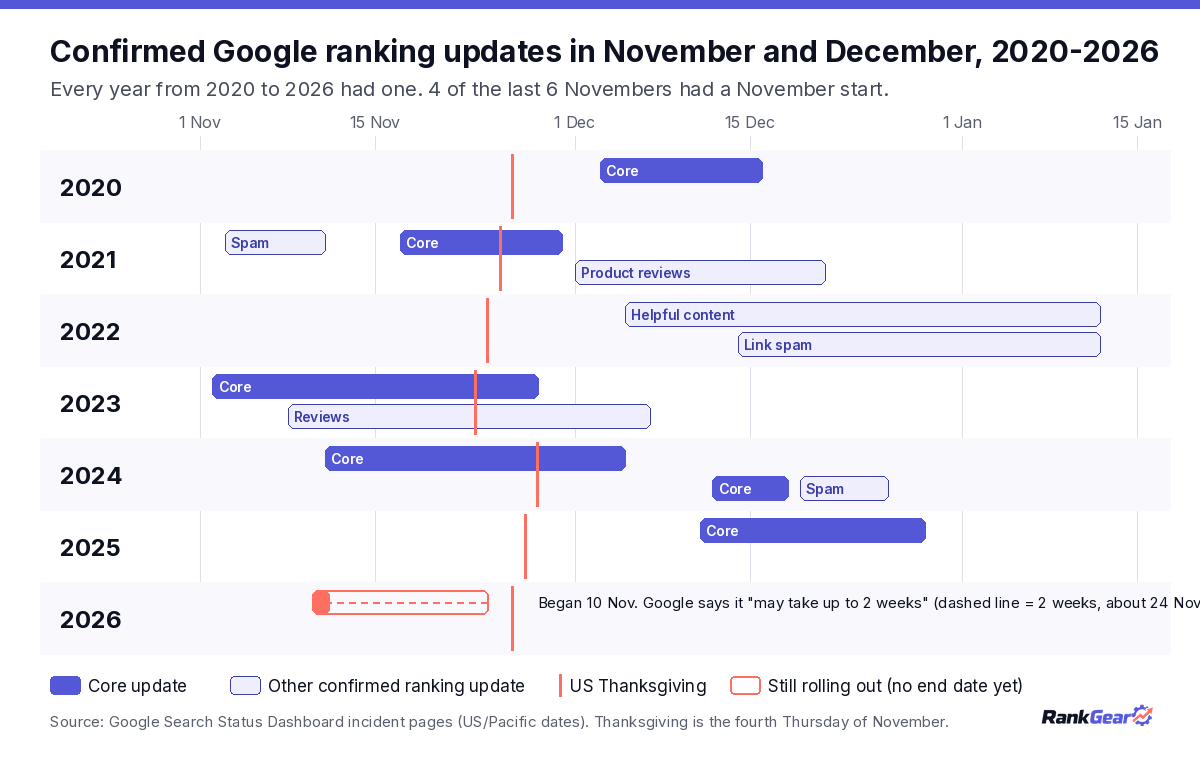
Several of those November rollouts were still running on US Thanksgiving. The November 2021 core update ran 17 to 30 November, across Thanksgiving on 25 November. The November 2023 core update ran 2 to 28 November and the November 2023 reviews update ran 8 November to 7 December, so both crossed Thanksgiving on 23 November. The November 2024 core update ran 11 November to 5 December, across Thanksgiving on 28 November. This year’s rollout could join that list if it runs close to 2 weeks or longer.
In a 2 November 2023 Search Central post, Danny Sullivan wrote: “We do try to avoid having updates during the late-November to mid-December period when possible. But it’s not always possible.” He added that Google releases updates “when they’re ready.” That is Google describing its own intent, and the November 2023 core update started the same day and ran through Thanksgiving. In 2013, Matt Cutts, then at Google, wrote “we try to minimize major updates right before the holidays,” as also reported by Search Engine Roundtable the next day. As reported by Search Engine Land, at a September 2023 Pubcon AMA, Gary Illyes called the holiday pause an “old thing.” He also said, “I don’t think we should stop releasing updates in that period of time.”
We found no official study or verified industry dataset showing that November updates hurt businesses that prepared for holiday search. The record shows a timing pattern and a risk. If you spent months positioning pages for holiday queries, a core update may move that visibility in the same weeks that seasonal demand peaks. Google’s core updates documentation says “this constant change can cause both gains and drops in organic Search traffic.” Google’s 2023 Q&A also says that for people already making helpful, people-first content, “chances are, there’s nothing to do for most creators,” and some may find themselves performing better. Treat both as Google’s claims and check them against your own data.
The mid-November 2003 “Florida” update was an industry name for a shake-up Google never formally announced. Search Engine Land’s retrospective quotes Google research scientist Craig Nevill-Manning: “whenever we change our algorithm, it’s going to hurt some people and help some others.” That risk is why the measurement steps below matter most in November.
Why mid-rollout core update ranking changes are not a verdict
Google’s core updates guide puts one step before any analysis: confirm on the dashboard that the rollout has finished, and note its start and end dates. A rank check on day 2 (11 November 2026) skips that step and shows a field that is still moving.
Google’s traffic-drop guide says small changes in position “can happen at any time,” including moving back up without you doing anything. It also says you “shouldn’t focus too much on your absolute position,” and that “impressions and clicks are ultimately the measure of success for your site.”
Google also gives two examples of scale. In its small example, a page drops from position 2 to 4. Google says there’s “no need to take drastic action” there and recommends “avoiding making changes to content that’s already performing well.” In its large example, a page drops from position 4 to 29, and Google calls for a “deeper assessment.” Both examples come after Google’s step of confirming the rollout is done.
RankGear’s Volatility feature exists for this problem. It repeats the same query across a set number of samples and records how far positions move when nothing on your page has changed. That gives you a noise baseline before you attribute rank movement to an edit, a campaign or an algorithm update. Volatility describes movement and does not explain its cause. We made the same point about AI answers in one AI Overview citation is not evidence, where a single snapshot of a moving field tells you about that moment and little else.
Google’s official method for measuring a core update
Google’s core updates documentation, last updated 2025-12-10 UTC, sets out a short method for a change in traffic “that correlates with a core update.” It is standing guidance and was not written for this rollout.
Confirm the core update rollout has finished, then wait a week
First, check the dashboard incident for a completion note and record the start and end dates. Second, Google recommends “waiting at least a full week after a core update completes before analyzing your site in Search Console.” Take the end date from the dashboard instead of guessing “about two weeks.” For scale only, the dashboard shows the last two Search core updates took 11 days, 21 hours (May) and 12 days, 4 hours (March). The December 2025 core update took 18 days, 2 hours. None of those is a forecast for this rollout.
Compare Search Console after the core update with the week before it started
Google then suggests comparing “this week with a week before the core update started rolling out.” For this update, that baseline is a week before 10 November. Review your top pages and queries instead of one sitewide average. Google also says to analyze search types separately: Web Search, Google Images, Video mode and the News tab.
The traffic-drop guide adds checks to run at the same time. Set the Search Console date range to “Last 16 months” so you can see the same season last year. Compare the drop with a similar period, or year over year. Filter by query, page, country, device and search appearance. The same guide lists other causes of a drop: technical issues, security issues, spam or manual actions, seasonality and changing interests, and site moves. A drop that starts on 10 November has a timing association with the update. That timing helps you prioritize investigation. It does not prove cause, as our guide to correlation vs causation in SEO explains.
Where core update measurement collides with US holiday search demand
US Thanksgiving 2026 falls on Thursday, 26 November. Black Friday is 27 November and Cyber Monday is 30 November. These dates come from the US calendar and are not Google announcements.
If the rollout runs the full 2 weeks from its 10:06 US/Pacific start, it would end around 24 November. The first full week after that would include Thanksgiving, Black Friday and Cyber Monday. A shorter rollout, close to the roughly 12 days that March and May took, would end around 21 or 22 November, and the following week would still cross Thanksgiving week.
Google’s traffic-drop guide uses a November example to explain seasonal search demand, not update timing: “Turkey has a strong seasonality, peaking every year in November.” So if you compare Thanksgiving week with a week in early November, a change in clicks may reflect demand, the update, ordinary SERP movement, or a mix. Search Engine Journal made the same point on 10 November. It noted that retail sites comparing that week with a pre-update week “would be looking at holiday traffic against a regular week.” This is a calendar inference from Google’s method. Google has not issued a Thanksgiving warning for this update.
The risk is highest for US retail, shopping, travel and food queries, and for sites whose clicks peak in late November. It is lower for queries with steady demand all year (Google’s example is coffee) and for sites outside the US. Before anyone writes “the core update did this,” check year over year, look at Google Trends for the queries that drive your clicks, and filter by query.
How to separate core update impact from ordinary SERP noise and seasonality
Ask three questions for each priority query, and keep the answers apart. Did your page change? Did the competing field for this query change? Is this query usually this noisy, and is demand moving with the season?
Diff and Trends answer the first two. Diff compares two saved runs for the same keyword and shows factor, rank or progress changes. Trends builds a run-over-run history from saved runs. Keep the query, market, device and depth the same on every run so the comparisons hold.
Volatility answers the noise half of the third question. A baseline from the week before 10 November, plus earlier periods if you have them, keeps a 2-to-4 position wobble from being reported as a collapse. The demand half comes from the 16-month Search Console view, a year-over-year comparison and Google Trends. Google’s traffic-drop guide asks for the same checks.
Keep Search Console clicks and impressions in one column and live SERP field measurements in another. Do not merge them into one “impact score.”
A practical core update measurement playbook for SEO teams
A sound plan freezes a baseline now, waits for a valid window, and checks demand before it names a cause.
- Freeze a baseline now. Export Search Console data for the week before 10 November. Capture the SERP field for priority queries with a RankGear Analysis Run or another capture method, and record market, device and depth.
- Watch the dashboard incident until Google posts a completion note. Day 8 of a rollout that may take 14 days is still mid-rollout.
- Wait at least one full week after completion. If that week is 26 November to 2 December for a US seasonal site, do not use it as your only “after” window. Add a year-over-year check, and wait for a post-holiday week if you need one.
- Compare position, clicks and impressions. Split search types, and use query and page tables, not only domain totals.
- Classify the move with Google’s examples (small: 2 to 4, large: 4 to 29) and with the query’s pre-update noise range.
- Only after a large drop that lasts past the valid window, run Google’s helpful content self-assessment. Then measure the page against the current field before you rewrite, and change one thing at a time if you test a fix. Google says some changes “can take effect in a few days,” but “it could take several months,” and there’s “no guarantee” a change will have a noticeable effect.
- For client reports, show the trend over time, the comparison windows and the seasonality check. Leave out the mid-rollout screenshot.
What not to change during the core update rollout
Hold off on emergency rewrites that change many things at once, and on panic title-tag edits. Google also warns against “quick fix” changes, such as “removing some page element because you heard it was bad for SEO.” Google calls deleting content “a last resort.” If you bundle several fixes mid-rollout, you lose the ability to tell which one mattered. Our post on how we run a controlled SEO experiment shows how to test one change at a time.
Keep useful work that was already planned and has nothing to do with “fixing the update.” Just don’t credit later movement to that work until the field settles and the window is valid.
“See what actually ranks” still holds. Run that check after the rollout is complete and after you have checked demand, and keep the mid-rollout screenshot out of client verdicts.
Google core update measurement FAQs
When will the core update rollout finish?
Google has not posted an end date. As of 11 November 2026, the dashboard lists the November 2026 core update as active, with no new message since the 10:07 PST launch note. Google says the rollout may take up to 2 weeks. That is an estimate. The November 2024 core update carried the same note and ran from 11 November to 5 December. Watch the incident page for a completion note. See Confirm the core update rollout has finished, then wait a week.
Can I judge core update impact from rankings during the rollout?
No. Google’s core updates guide says to confirm the rollout has finished and then wait at least a full week before analyzing Search Console. Google’s traffic-drop guide also says small position changes can happen at any time and can reverse on their own. See Why mid-rollout core update ranking changes are not a verdict.
How often do November core updates happen?
A confirmed update started in November in 4 of the last 6 Novembers (2021, 2023, 2024 and 2026), per Google’s ranking history. In 2022 and 2025 the late-year updates came in December. Widen the window to November or December and there is a confirmed update in every year from 2020 through 2026. See The late-year core update pattern and the risk to holiday SEO plans.
Does a traffic drop that correlates with a core update prove the update caused it?
No. Google’s traffic-drop guide treats an update as one possible cause, next to technical issues, security issues, spam or manual actions, seasonality, and site moves. A drop that starts on 10 November is a timing association. In late November, holiday demand can move clicks at the same time. See Compare Search Console after the core update with the week before it started.
Why is the Search Console comparison risky this November?
The first full week after completion may land on US Thanksgiving week. If the rollout runs the full 2 weeks, it ends around 24 November (dashboard start time), and the next week includes Thanksgiving (26 November), Black Friday (27 November) and Cyber Monday (30 November). Comparing that week with early November mixes holiday demand with any update effect. See Where core update measurement collides with US holiday search demand.
Can RankGear tell me whether the Google core update hit my site?
No. Volatility, Diff and Trends show how a query’s SERP field and your page moved across saved runs. Volatility describes movement and does not explain its cause, so none of these tools assigns a move to the core update. Use them to keep the evidence in order while you run Google’s method.
Sources
- Google Search Status Dashboard. November 2026 core update. https://status.search.google.com/incidents/WLxcJyC6jMWMfryxsKMc (began 2026-11-10 10:06 US/Pacific; active as of 11 November 2026)
- Google Search Status Dashboard. Ranking updates history. https://status.search.google.com/products/rGHU1u87FJnkP6W2GwMi/history
- Google Search Central. Google Search’s core updates and your website. https://developers.google.com/search/docs/appearance/core-updates (last updated 2025-12-10 UTC)
- Google Search Central. Debug Google Search traffic drops. https://developers.google.com/search/docs/monitor-debug/debugging-search-traffic-drops (last updated 2025-12-10 UTC)
- Google Search Central Blog (2 November 2023). A Q&A on Google Search updates. https://developers.google.com/search/blog/2023/11/q-and-a-on-search-updates
- Google Search Central. Creating helpful, reliable, people-first content. https://developers.google.com/search/docs/fundamentals/creating-helpful-content
- Google Search Status Dashboard incidents: May 2026 core https://status.search.google.com/incidents/wdAXJk6LRRihEjpzEeWE ; March 2026 core https://status.search.google.com/incidents/7eTbAa2jWdToLkraZj5y ; February 2026 Discover https://status.search.google.com/incidents/mYbNTqV1ytDc2fA8hUz4 ; December 2025 core https://status.search.google.com/incidents/DsirqJ1gpPRgVQeccPRv ; September 2026 spam https://status.search.google.com/incidents/XhUDXP7A67iHCD2kmbVu
- Google Search Status Dashboard incidents, 2020-2024 late-year updates: https://status.search.google.com/incidents/YDVnErNJQ7Pz3qwuLdQS ; https://status.search.google.com/incidents/AFdXceQVsh1GEfKFvHyD ; https://status.search.google.com/incidents/FncPfR7zRSZ3diemah4o ; https://status.search.google.com/incidents/hgwP7ei5H1uKbYSeZrBZ ; https://status.search.google.com/incidents/XMdX5PmbMvKW4fv3CRvn ; https://status.search.google.com/incidents/CxXUEK28vCKqkNocPhKR ; https://status.search.google.com/incidents/WtY1CQgfqrr2cjxKbyUk ; https://status.search.google.com/incidents/VqRTcmyQCwfpuYeaVNfn ; https://status.search.google.com/incidents/G7rp11wqTaTGn6JjiPF3 ; https://status.search.google.com/incidents/V9nDKuo6nWKh2ThBALgA ; https://status.search.google.com/incidents/UUq2WSouY7PhSm8zvtD1
- Search Engine Journal (10 November 2026). Google’s November 2026 core update starts rolling out. https://www.searchenginejournal.com/google-november-2026-core-update/596614/
- Search Engine Roundtable (19 December 2013). Google’s Matt Cutts responds to major updates reports. https://www.seroundtable.com/google-major-updates-17842.html
- Search Engine Land (21 September 2023). AMA with Google’s Gary Illyes: 15 quick SEO takeaways. https://searchengineland.com/ama-google-gary-illyes-seo-takeaways-432325
- Search Engine Land (14 November 2023). Google’s Florida update: 20 years since the SEO ‘volcanic eruption’. https://searchengineland.com/google-florida-update-434540
- RankGear. One AI Overview citation is not evidence. https://rankgear.com/ai-overview-citation-volatility/
- RankGear. Correlation vs causation in SEO: how to read a ranking-factor study. https://rankgear.com/correlation-vs-causation-in-seo/
- RankGear. How we run a controlled SEO experiment. https://rankgear.com/how-we-run-a-controlled-seo-experiment/
- Matt Cutts (@mattcutts), 18 December 2013. “@Bessian Actually, we try to minimize major updates right before the holidays.” https://x.com/mattcutts/status/413422455428890624 (verified 11 November 2026; also reported the next day by Search Engine Roundtable, item 10)