Citation screenshots tempt bad AI Overview reporting
Stakeholders want a yes or no: are we in the AI Overview? Someone screenshots Tuesday and calls it a win. One day’s citation presence is noise, and a single snapshot can’t separate progress from movement.
AI Overviews show up often enough in commercial SERPs that bad measurement spreads fast. In Babel42’s AI Overviews 2026 study (published 12 October 2026), an AI Overview showed up on 90.2% of 600 high-volume US-English commercial searches on 26 September 2026. Finance and health sat at 98%, and local services at 79%. Search Engine Roundtable (26 October 2026) summed up third-party trackers that also reported “over 80%”. Those came from different vendor samples (SE Ranking’s 82.5% of US brand searches, seoClarity industry ranges roughly 55-84%). None of those is a Google-official figure. Quote only the sample you can name and defend.
Babel42’s 15-day citation panel and Laurelin Labs’ pre-registered fan-out study give you a reporting line without turning either study into a product promise.
Ranking is not the same as AI Overview citation
Babel42 recorded organic top-10 results and AI Overview citations for 600 commercial searches on 26 September 2026. The overlap is real, and the gaps are large.
- Of 3,415 sites cited across those searches, 45.7% had no page in the organic top 10 for the same search (Babel42).
- Of 5,316 page-1 results, only 32.3% were cited by the AI Overview on the same search.
- The #1 organic result was cited 48.8% of the time. The #10 result 21.5%.
Higher organic rank is associated with a higher chance of citation in this sample. Still, page-one work and citation work are different jobs.
Google draws the line the same way. In AI features and your website (last updated 2025-12-10 UTC), Google states that AI Overviews and AI Mode may use a “query fan-out” technique. Core SEO still applies, and there is no special schema, markup, or machine-readable AI file needed to be included. You still need normal Search indexing and snippet eligibility.
Two Babel42 checks from that panel are worth keeping apart:
- Across 8,295 AI Overviews over 16 days, YouTube was cited in 63.3% of answers (Babel42).
- For 475 searches where both surfaces cited sites, AI Overviews and AI Mode shared only 32.5% of cited sites on average. A hit on one surface does not count for the other.
Earlier scale, older window: Ahrefs’ March 2026 Brand Radar update said that roughly 37.9% of AI Overview-cited URLs also showed up in the first 10 SERP blocks. Organic top-10 share sat around 37.1% (Ahrefs). Keep that as older context beside Babel42’s fresher window.
One day is noise: AI Overview citation sets flip
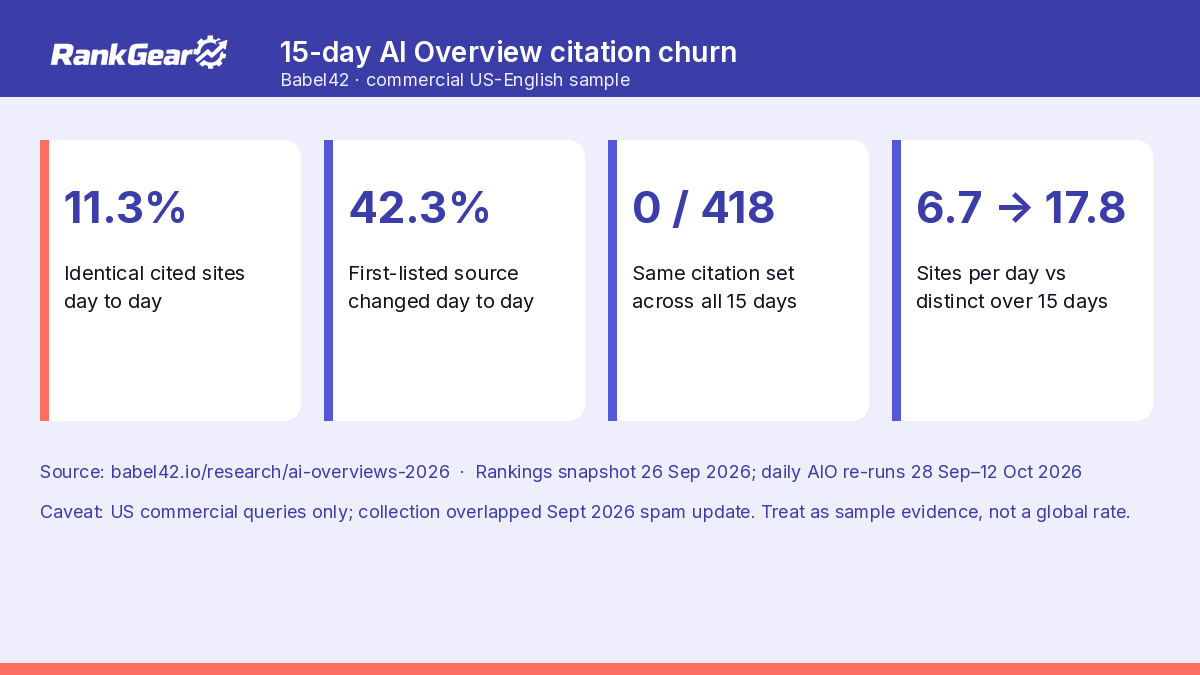
Babel42 re-ran 601 searches that had an AI Overview on 26 September. It ran them every day at 13:00 UTC from 28 September through 12 October 2026 (fifteen daily runs). Day to day, the citation set barely stays put.
Across daily comparisons (Babel42):
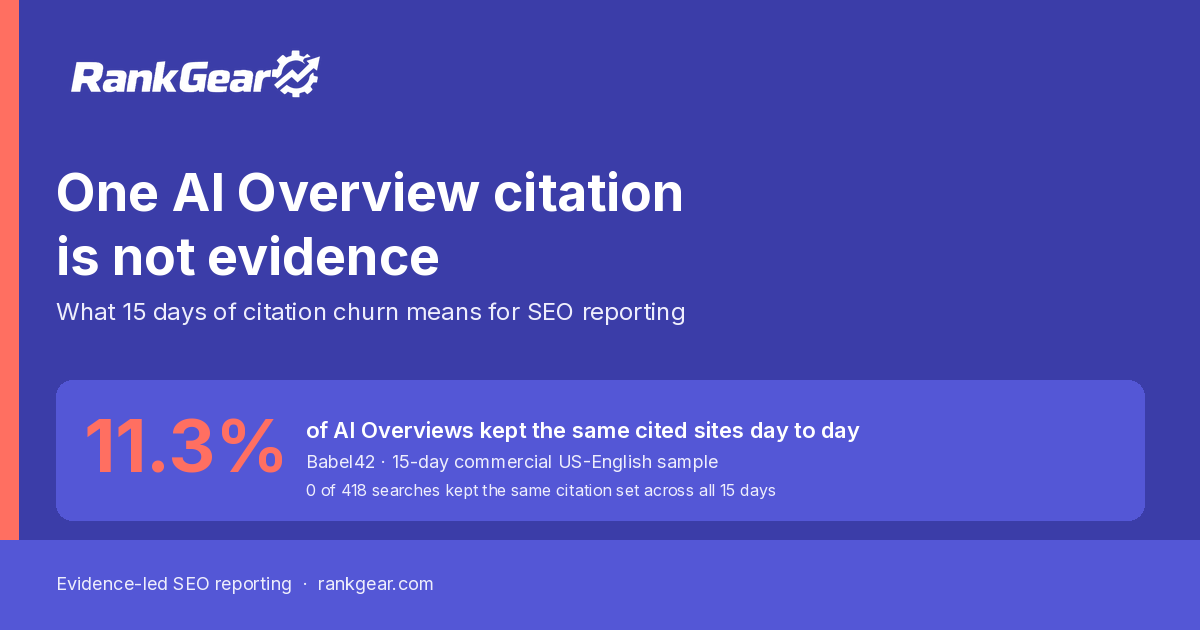
- Only 11.3% of AI Overviews cited exactly the same sites as the day before (average across day-to-day pairs).
- The first-listed source changed in 42.3% of searches from one day to the next.
- Of 418 searches with a cited AI Overview on all 15 days, none kept the same citation set every day.
- Each Overview cited about 6.7 sites on a given day, but about 17.8 distinct sites across the 15-day window.
A screenshot from Tuesday is evidence about Tuesday, and little else.
Treat AI Overview citations like SERP volatility
Borrow RankGear’s organic language here as analogy, not as a shipped AI Overview feature. Volatility measures how much a result set moves across many samples when you haven’t changed the page. Diff and Trends keep dated history so you can tell “we edited” from “the SERP moved.”
Use the same habit for AI Overview reporting:
- Sample the same query, market, and device across many days (same time window when you can).
- Report how often you get cited and whether the first source stays put, not a yes/no.
- Keep organic-rank tracking on a separate track from citation tracking.
- Do not attribute a one-day show-up or drop to a page edit until you have enough samples to see past the baseline churn.
Caveat on the Babel42 window: collection started two days after Google began rolling out the September 2026 spam update. The roll-out began 2026-09-24 09:15 US/Pacific and completed 2026-10-08 01:00 US/Pacific. That overlap can confound day-to-day churn. Do not blame the spam update for the churn without evidence. State Babel42’s limits up front: US English, high-volume commercial queries (not a random sample of all Google searches), with ranking comparisons locked to the 26 September snapshot.
Fan-out coverage is not an AI Overview citation score
Google confirms that AI Overviews and AI Mode may use query fan-out (AI features doc). Tools now score pages by how many guessed sub-queries they “answer,” on the idea that coverage raises citation odds.
Laurelin Labs’ pre-registered fan-out study (spec dated 2 November 2026, figures describe October-November 2026) fixed its decision rules before outcome data. On 158 test queries (1,190 candidate pages, 670 cited), conditional logistic models found:
- Head-query organic rank was strongly associated with citation: odds ratio 0.43 per standard deviation of log rank (better ranks → higher citation odds).
- Longer pages were associated with citation: odds ratio 1.30 per SD of log word count.
- Fan-out coverage, sub-query top-10 presence, and heading match failed the pre-registered out-of-sample discrimination bar (within-query AUC change about −0.003 to +0.004, against a required gain of +0.02).
- Seen fan-out was small: 2.35 sub-query clusters per keyword versus 16.1 guessed.
- Gemini ran no search at all in 47% of 705 Gemini calls.
- Of cited pages outside the head-query top 10, only 14% ranked in the top 10 for any observed sub-query.
An association inside a sample is not a coverage score you can sell as a citation predictor. It also does not mean Google never fans out. Guessed sub-query lists are larger than the real set. Related searches and questions still help as content research, not as a ranking formula.
RankGear already trains the same care when people read ranking-factor correlations. A relationship in a measured field helps you decide what to check next without turning into a sure claim.
Disclose Laurelin’s limits whenever you cite this paper with a client. The study uses an observational design, and Gemini API (and Claude) tool searches stand in for internal AIO fan-out (not a direct look at Google’s internal searches). The sample skews toward domains Laurelin had audited, and Laurelin sells AI-visibility consulting (competing-interest disclosure on the paper).
What page evidence shows for AI Overview citations
Babel42 compared page-1 pages that AI Overviews cited with pages they ignored at the same organic position, so rank was not doing the work (Babel42):
- Under 500 words: 25.4% of ignored pages vs 16.5% of cited pages.
- No named author: 48.5% ignored vs 42.4% cited.
- Ignored pages also more often had fewer headings and no list or table.
These are same-position associations in one commercial sample, useful as checks to run. They do not prove that word count or a byline causes citation.
Where the quote came from is clearer. Of 1,702 AI Overview passages traced back to page main text, 67% came from the first 30% of the page, and the first fifth alone gave 56%. Put the answer early if you want a sentence ready to quote.
Google’s October 2026 guidance lines up with that:
- Google’s using generative AI content guidance (updated 2026-10-01 UTC) says it is key to fact-check and review all AI-made content by hand, including metadata (titles, meta descriptions, structured data, image alt text).
- Google’s creating helpful, reliable, people-first content guidance warns against deceptive authorship (fake headshots, made-up names, false credentials) as a signal of a low-quality page. Search Engine Land covered the authorship warning on 2026-10-06.
When you brief the client, open with those same-position associations and the early answer placement. Park Helpful Content Evidence beside them as a field check, not a score. RankGear’s Helpful Content Evidence signals cover visible authorship, author-profile links, About/editorial routes, sourcing, method headings, tables/figures, AI/automation disclosure, title/H1 support, and question→answer blocks. They are evidence you can compare across the pages ranking for this query, not a Google helpfulness score. A byline still does not prove expertise, and a disclosure still does not prove quality. Original experience and factual accuracy stay human questions.
How to report AI Overview citation frequency
You can run this without claiming RankGear measures AI Overview citations:
- Define the field the way you would for an Analysis Run. Fix the query, market/language, device, and depth before you collect either organic or AI Overview samples.
- Sample citations across many days. Prefer the same clock window. Report how often you get cited (e.g., cited on N of M days) and whether the first source stays put, not a single screenshot.
- Keep organic rank and citation on separate tracks. Babel42’s 45.7% non-top-10 citation share is why mixing them makes false wins and false losses.
- If you test a page change aimed at citation, change only one thing. Use an Experiments approach: one change, enough samples to see past day-to-day noise, and a clear baseline.
- For content structure: answer-first placement, honest authorship with no fake bylines, real methods and sourcing, human fact-check of AI drafts and metadata (per Google’s gen-AI guidance).
- For client reporting: show the spread over the window. Drop the one-day yes/no “we’re in / we’re out” slide.
Related searches and People Also Ask are still useful for content research. Leave guessed fan-out lists off the citation-predictor shelf until a within-query, out-of-sample test says otherwise.
AI Overview citation FAQs
Is one AI Overview citation proof of progress?
No. Babel42’s 15-day panel found only 11.3% of AI Overviews cited exactly the same sites as the day before, and none of 418 always-on Overviews kept the same citation set across all 15 days (Babel42). Report how often you get cited over repeated samples (see One day is noise: AI Overview citation sets flip).
Does ranking on page one mean an AI Overview will cite you?
No. In Babel42’s 26 September snapshot, 45.7% of cited sites had no page in the organic top 10 for the same search, and only 32.3% of page-1 results were cited (Babel42). Higher rank raises the chance of citation in that sample without finishing the job. See Ranking is not the same as AI Overview citation.
Do fan-out coverage scores predict AI Overview citation?
Not in Laurelin Labs’ pre-registered test of coverage scores. Once head-query rank and page length were in the model, coverage, sub-query top-10 presence, and heading match failed the out-of-sample discrimination bar (Laurelin Labs). Use related searches as content research, not as a citation formula. See Fan-out coverage is not an AI Overview citation score.
Do AI Overviews and AI Mode share the same cited sources?
Not closely enough to treat them as one surface. For 475 searches where both cited sites, they shared only 32.5% of cited sites on average (Babel42). If both surfaces matter to stakeholders, sample both.
How should teams report AI Overview citation visibility?
Define the query field, sample across many days in the same window, report how often you get cited and whether the first source stays put, and keep organic rank on a separate track. Show the spread over the window instead of a one-day screenshot. See How to report AI Overview citation frequency.
Does RankGear measure AI Overview citations?
No. This article uses RankGear’s SERP-noise language (Volatility, Diff, Trends, Experiments, Helpful Content Evidence) as an analogy for how to report a noisy surface. It does not claim RankGear tracks, scores, or predicts AI Overview citations.
AI Overview citation evidence becomes ordered work
“See what actually ranks” still holds for normal SERPs. For AI answers, ask the paired question out loud: what actually gets cited, and how often?
A study coefficient, a coverage score, or a one-day Overview hit can prioritize investigation. None of them should become a ranking or citation promise. Measure the field you care about, keep the math and the sample limits in view, and report how often you show up when the surface itself is noisy.
Sources
- Babel42 (2026). AI Overviews statistics 2026: what Google’s AI cites. (published 12 October 2026; CC BY 4.0)
- Laurelin Labs. Answering the fan-out does not predict AI Overview citation: a pre-registered test across 235 queries. (Oct-Nov 2026 data; spec 2 November 2026)
- Google Search Central. AI features and your website. (last updated 2025-12-10 UTC)
- Google Search Central. Using generative AI content. (updated 2026-10-01 UTC)
- Google Search Central. Creating helpful, reliable, people-first content.
- Google Search Status Dashboard. September 2026 spam update. (2026-09-24 → 2026-10-08 US/Pacific)
- Search Engine Land (2026-10-06). Google warns against using fake author information on your content.
- Search Engine Roundtable (2026-10-26). Over 80% of Google searches have AI Overviews. (vendor-sample roundup; not Google-official)
- Ahrefs (2026-03-02). Update: 38% of AI Overview citations pull from the top 10. (older large-scale context)
- RankGear. Correlation vs causation in SEO: how to read a ranking-factor study.
- RankGear. How we run a controlled SEO experiment.