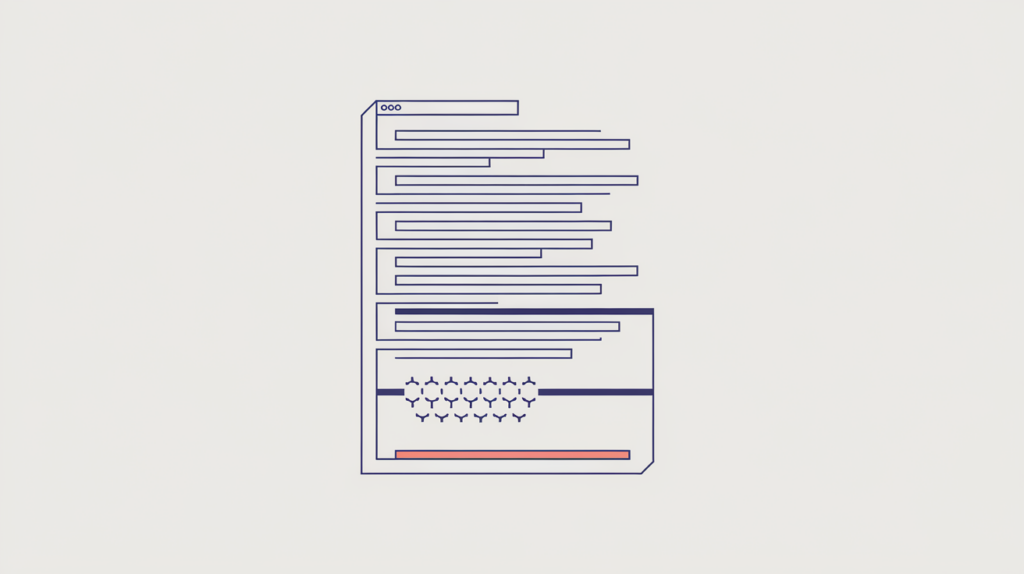
This factor counts how many keyword variations appear in the final 100 qualifying words of a page’s cleaned content. It is an observation about how a page closes, not a target to pad — a higher count tracks with, but does not cause, position within a measured result set.
| Factor ID | RG-KWD-088 |
|---|---|
| Family | Keyword Usage & Density |
| Measurement | Variation occurrence count |
| Measured zone | Last 100 cleaned word tokens |
What it measures
RankGear counts the keyword variations that occur inside the final 100 qualifying words of the cleaned page content. It looks only at the tail of the document — the words a reader reaches last — and reports how often your tracked variations surface there. It is a positional reading of where variations land, not a measure of total keyword usage across the whole page.
How RankGear measures it
RankGear tokenizes the cleaned content with its 3-to-64-character word pattern, selects the last 100 tokens, and sums case-insensitive whole-word variation matches independently over those tokens. Each qualifying token is checked against every tracked variation on its own, so a single word can contribute to the count when it matches a variation exactly. The comparison ignores case and requires a whole-word match rather than a substring.
How to read it
| If the tail of your page is… | What the count reflects |
|---|---|
| A natural conclusion or next-steps summary | Variations appear where the topic genuinely closes — the healthy pattern |
| Sparse or off-topic (e.g. boilerplate footer) | A low count that reflects thin topical closure, not a penalty to fix by stuffing |
| An artificial keyword recap | A high count that reads as padding to humans and adds no real value |
How to optimize it
Treat this as an observation, not a target. End the page with useful topical closure — a concise conclusion, clear next steps, or a genuine summary — rather than an artificial keyword recap bolted on to raise the number. When the closing content is on-topic and written for the reader, relevant variations tend to appear on their own. Do not stuff the final paragraph to inflate the count.
Important considerations
- Pages with fewer than 100 tokens use all available tokens, so short pages are measured over their entire cleaned content.
- Per-token matching favors single-word variations over phrases, because each token is checked independently and multi-word phrases will not register as a whole-word match against one token.
- Footers may enter the final token window, so repeated site-wide footer text can influence what gets measured at the tail.
- Source order influences which content is measured, since the last 100 tokens depend on the order content appears in the cleaned document.
- This is a correlational, positional signal. A higher count relates to how a page ranks within a measured result set; it does not make a page rank or guarantee a position.
Related factors
Part of the Factors reference · how RankGear measures · glossary.