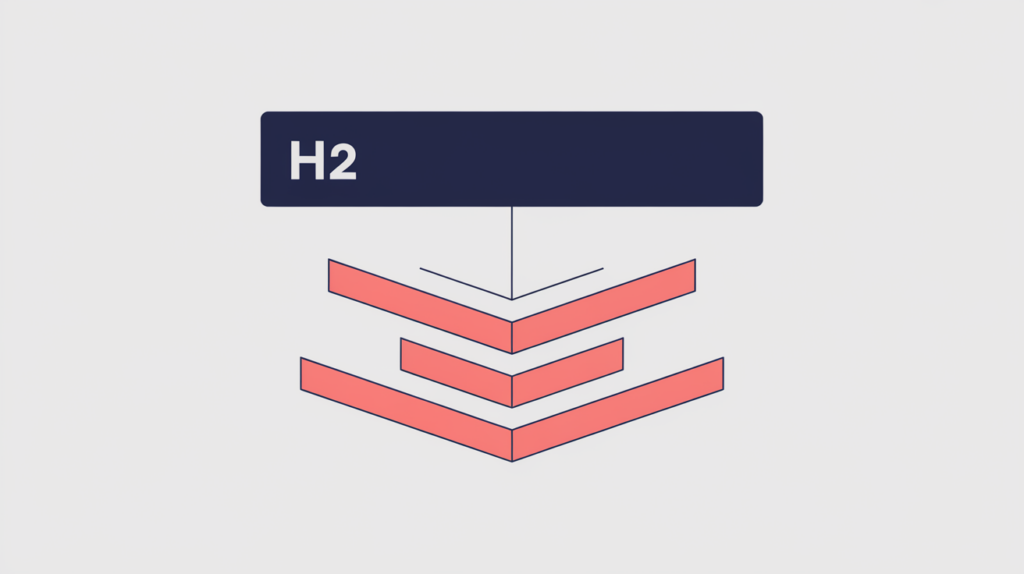
Number of H3 Tags counts the H3 heading elements RankGear finds in the rendered page body — a read on how finely a page subdivides its major H2 sections into supporting topics. It counts quantity only, so any number is context to weigh against the ranking pages, never a target to hit or a guarantee of position.
| Factor ID | RG-HDG-028 |
|---|---|
| Family | Headings |
| Measurement | Count |
| Measured zone | Rendered page body |
What it measures
Number of H3 Tags counts the H3 elements in the rendered page body. It lets you compare how deeply the target page and the ranking pages break major H2 sections into supporting topics. The factor reflects tag quantity only — it does not judge whether the heading hierarchy is logical, or whether the H3 text is useful, visible, unique, or relevant.
How RankGear measures it
RankGear scans the rendered, script-free page body for recognized opening and closing H3 elements and returns the number found. The parser accepts a limited amount of tag attributes and heading content, following RankGear’s compatibility rules. If no recognized H3 element is present, the value is 0.
What RankGear looks for
<h3>A supporting subtopic beneath an H2</h3>
<h3 class="...">Another labelled sub-section</h3>| If the page is… | Do this |
|---|---|
| Below a meaningful competitive H3 count | Review long H2 sections for natural subdivisions, and add H3s only where distinct supporting ideas earn their own label. |
| At or above the competitive count | Treat the number as an observation, not a target. Do not add H3s where a paragraph, list, or plain sentence reads more clearly. |
How to optimize it
Use H3 headings when an H2 section holds distinct supporting ideas that benefit from their own labels — steps, features, examples, questions, options, or evidence sitting beneath a broader section. If the target page is below a meaningful competitive goal, review its long H2 sections for natural subdivisions. Do not add H3 elements where a paragraph, a list, or a simple sentence is clearer. Read the count as an observation about structure rather than a quota to fill.
Important considerations
- The appropriate number depends on page length, complexity, type, and search intent.
- An H3 should normally support the nearest preceding H2 rather than replace a logical hierarchy.
- Styled text is not counted unless it uses an actual H3 element.
- Excessive subdivision can make content fragmented and harder to scan.
- Review H3 count alongside heading wording, keyword use, entities, and overall structure.
- This is a correlation-based prioritization signal, not a cause of ranking — matching a competitive H3 count does not by itself move position.
Related factors
Part of the Factors reference · how RankGear measures · glossary.